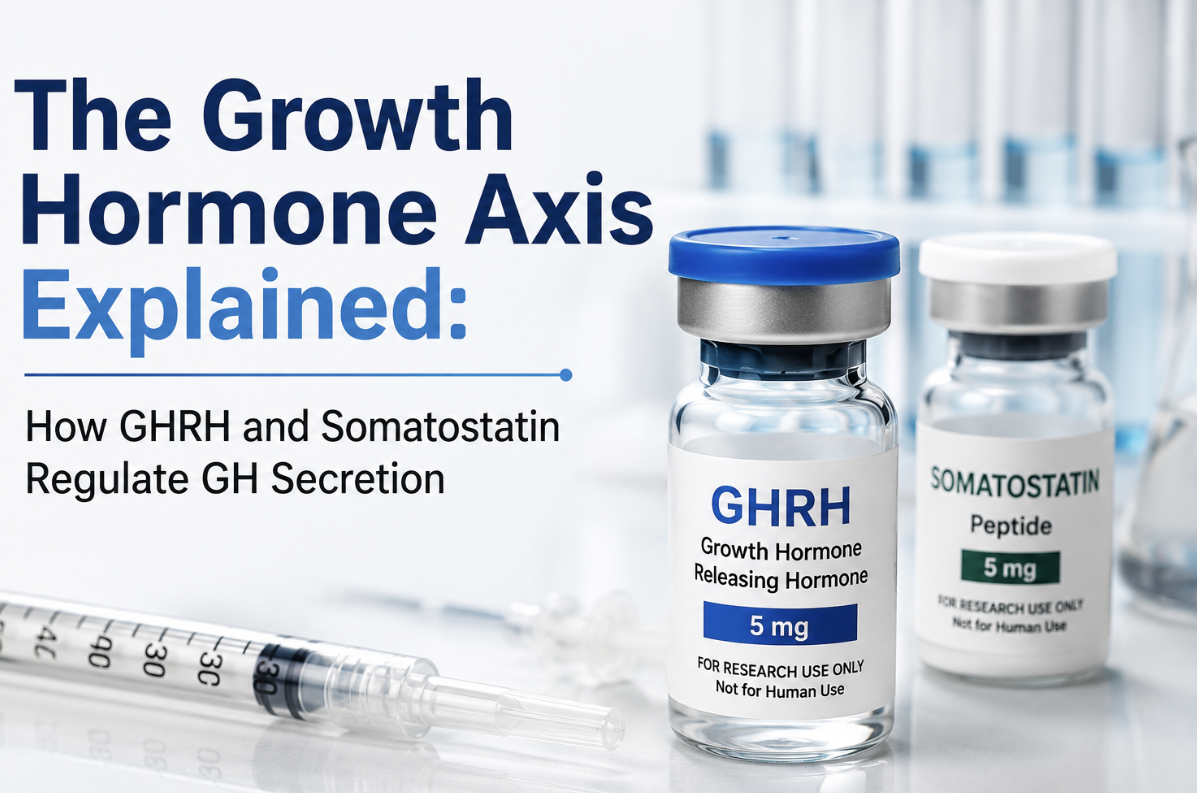
The Growth Hormone Axis Explained: How GHRH and Somatostatin Regulate GH Secretion
Growth hormone (GH) secretion is not a steady, constant process. It occurs in pulses, shaped by an intricate feedback system involving the hypothalamus, the pituitary gland, and peripheral tissues throughout the body. This system — often called the hypothalamic-pituitary-somatotropic axis, or simply the "GH axis" — is one of the most studied endocrine pathways in physiology and remains central to a large share of current peptide and metabolic research.
The Core Players
Three components form the backbone of this regulatory loop:
The hypothalamus, which releases two opposing signals that govern GH output
The anterior pituitary, home to somatotroph cells that synthesize and secrete GH
Peripheral tissues, particularly the liver, which respond to GH by producing insulin-like growth factor 1 (IGF-1) and feeding signals back into the loop
Understanding how these three interact explains why GH secretion looks the way it does — bursts of activity separated by quiet periods, rather than a flat baseline.
Growth Hormone-Releasing Hormone (GHRH)
GHRH is a 44-amino-acid peptide produced in the hypothalamus. When released, it travels to the anterior pituitary and binds to GHRH receptors (GHRHR) on somatotroph cells. This receptor binding activates the cAMP/PKA signaling cascade inside the cell, which triggers both the synthesis and the pulsatile release of GH.
GHRH is the primary stimulatory signal in this system. Without it, GH secretion drops sharply, which is why GHRH and its receptor have been such a persistent focus of endocrine research — they represent the "on" switch for the entire downstream cascade.
Somatostatin: The Counterbalance
Where GHRH stimulates, somatostatin inhibits. Also produced in the hypothalamus, somatostatin suppresses GH release from the pituitary, acting as a brake on the system. The balance between GHRH's stimulatory signal and somatostatin's inhibitory one is what produces the pulsatile pattern researchers observe — GH rises when GHRH dominates and falls when somatostatin activity increases.
This push-pull relationship isn't incidental. Many of the physiological effects associated with GH appear to depend on this pulsatile pattern specifically, rather than on cumulative hormone exposure over time. A study that only measures total GH output over a day, without accounting for pulse timing and amplitude, can miss important details about how the axis is actually functioning.
The Negative Feedback Loop
Once GH is released, it acts on peripheral tissues — most notably the liver — to stimulate production of IGF-1. IGF-1, in turn, feeds back to both the hypothalamus and pituitary, generally suppressing further GHRH release and GH secretion. This closes the loop: GH output leads to IGF-1 production, and elevated IGF-1 dampens subsequent GH release, keeping the system in a self-regulating equilibrium under normal conditions.
Ghrelin, a hormone primarily associated with appetite regulation, also plays a role here. It binds to a separate receptor — the growth hormone secretagogue receptor (GHSR) — on somatotrophs, providing an additional stimulatory pathway that can act synergistically with GHRH signaling. This is part of why GH-axis research often examines GHRH and ghrelin-receptor pathways together rather than in isolation.
Why Pulsatility Is Difficult to Study
One of the more persistent challenges in GH-axis research is that pulsatile secretion is hard to measure and even harder to model consistently. Blood sampling has to be frequent enough to capture individual pulses, and experimental interventions need to account for the fact that a compound affecting GHRH signaling, somatostatin signaling, or ghrelin-receptor signaling can shift not just total GH output, but the entire shape of the secretion pattern.
This is one reason researchers pay close attention to the pharmacokinetics of any compound used to probe this axis — a short-acting versus long-acting intervention can produce very different pulse patterns even if total hormone exposure ends up similar. Synthetic GHRH analogs such as 20mg tesamorelin are frequently used in this kind of work precisely because their modified structure gives researchers a more predictable pharmacokinetic profile to design around.
Age-Related and Metabolic Relevance
The GH axis doesn't operate in isolation from the rest of the body's physiology. GH secretion patterns change across the lifespan, generally declining with age, and the axis interacts closely with metabolic processes — particularly those involving adipose tissue and lipid handling. This overlap has made the GH axis relevant not just to classical endocrinology, but to a broader range of metabolic and aging-related research as well. Researchers looking to source verified material for this kind of work can find compound listings through suppliers such as Core Power Peptides.
Summary
The GH axis is best understood as a dynamic feedback system rather than a simple linear pathway. GHRH and somatostatin provide opposing signals to the pituitary, ghrelin-receptor signaling adds a parallel stimulatory input, and IGF-1 closes the loop through negative feedback. Grasping this architecture is foundational for interpreting almost any study that touches GH secretion, whether the focus is basic endocrinology, metabolic research, or the pharmacology of compounds designed to interact with one part of this pathway.