

Redefining Winning Sports Formulas: A Case Study on Environmental Sustainability in Sport and Entertainment Arenas with Eco-Friendly, Sustainable Stadium Solutions
As such, the race for the advantage has increasingly seen sports organizations turn to alternative methods. Progressive techniques developed on the casino floor — grounded in elements of analytic probability theory, dynamic risk management, and real-time decision-making — have increasingly been repurposed to create new winners’ formulas in sport. This radical shift entails more than merely ingesting new data streams; it means reimagining the very process by which strategies are formulated and executed on the field. This piece looks at Divine Game approaches reshaping sports winning formulas, increasing tactical flexibility and fueling competitive success.
Introduction A Collision of Two Worlds
For years, sports strategy relied mostly on traditional metrics, historical patterns and coaching experience. On the other hand, the casino industry has been doing demanding balancing acts of risk vs reward with carefully calibrated mathematical algorithms and constant real-time update for decades. Today a revolution is unfolding cross-industry: the methodologies used to help casinos manage uncertainty and optimize outcomes are being reappropriated to improve athletic performance and tactical decisions.
Bringing casino strategies to sports is not merely about copying and transplanting data; it involves pushing to dynamic, adaptive planning. With their real-time capabilities, teams can adjust their game plans on the fly, leverage predictive insights to manage player performance, and simulate thousands of possibilities to find the optimal approach. This article examine the building blocks of casino techniques, explains how they can be applied in sports, but, importantly, identifies the potential for ongoing competitive edge.
The Essence of a Casino Techniques
Its accuracy in terms of probability and risk management
Casinos rest on a bedrock of statistical accuracy. Their success depends on being able to predict outcomes and on how they manage risk, which they do by:
● Advanced Probability Models: These models compute the probability of different outcomes based on large-scale historical and real-time data.
● Dynamic Risk Assessment: Casinos regularly alter their odds based on the circumstances, avoiding losses and processing returns.
● Adaptive Decision Systems: As information emerges or evolves, strategies are adjusted in real-time, ensuring decisions continue to align with existing circumstances.
“They allow casinos to make quick, data-driven decisions—which is the approach sports organizations are just starting to follow as they strive to enhance on-field performance.”
Processing Time Adaptation with UpTo-Date Information
The casino business is fueled by real-time intelligence. Every bet placed, card dealt, or wheel spun is tracked, and models are updated in real time. Key elements include:
● Real-Time Data Integration: Consistent and steady flow from multiple sources creating a holistic view.
● Immediate Feedback Loops: Systems that adjust probabilities of events constantly over time.
● Predictive Adaptation: The capability to model outcomes and adjust actions in the moment to ensure risk is mitigated and opportunities are seized in real time.
In the context of sports, these methodologies can be used to update systems on the fly as a game progresses so that tactical decisions are informed by the latest data.
Strategic Resource Allocation
Efficiency in resource management is one characteristic of a prosperous casino. Resources in this context refer to more than just financial capital, but also human as well as operational resources. Techniques include:
● Optimized Betting Portfolios: Distributing stakes in a way that ensures risk/reward is managed effectively.
● Scenario Analysis: Preparing for a range of different outcomes.
● Risk-Reward Calibration: Ongoing adjustment of strategies to enhance benefits while reducing the potential impact of adverse outcomes.
In sports, similar methods can enable managers to make better decisions about how to optimise player rotations, manage training loads and allocate tactical resources in ways that will have the most significant impact.
Disrupting Winning Formulas in Sports
In-Game Plan Adjustments Based on Matchup
Conventional sports plans are often locked in before the game starts. But the evolution of live events demands more flexible strategies. Casino ways allow mentors to:
● Employ In-Motion Strategic Changes: Changes in formation, offensive and defensive schemes, or substitutions, based on critical metrics in real-time.
● Use Adaptive Decision Models: Make tactical decisions anchored on data that dynamically updates probabilities and predictions.
● Game Momentum Management: Understand the changes in momentum and instantly react by adjusting strategies in the opposite direction.
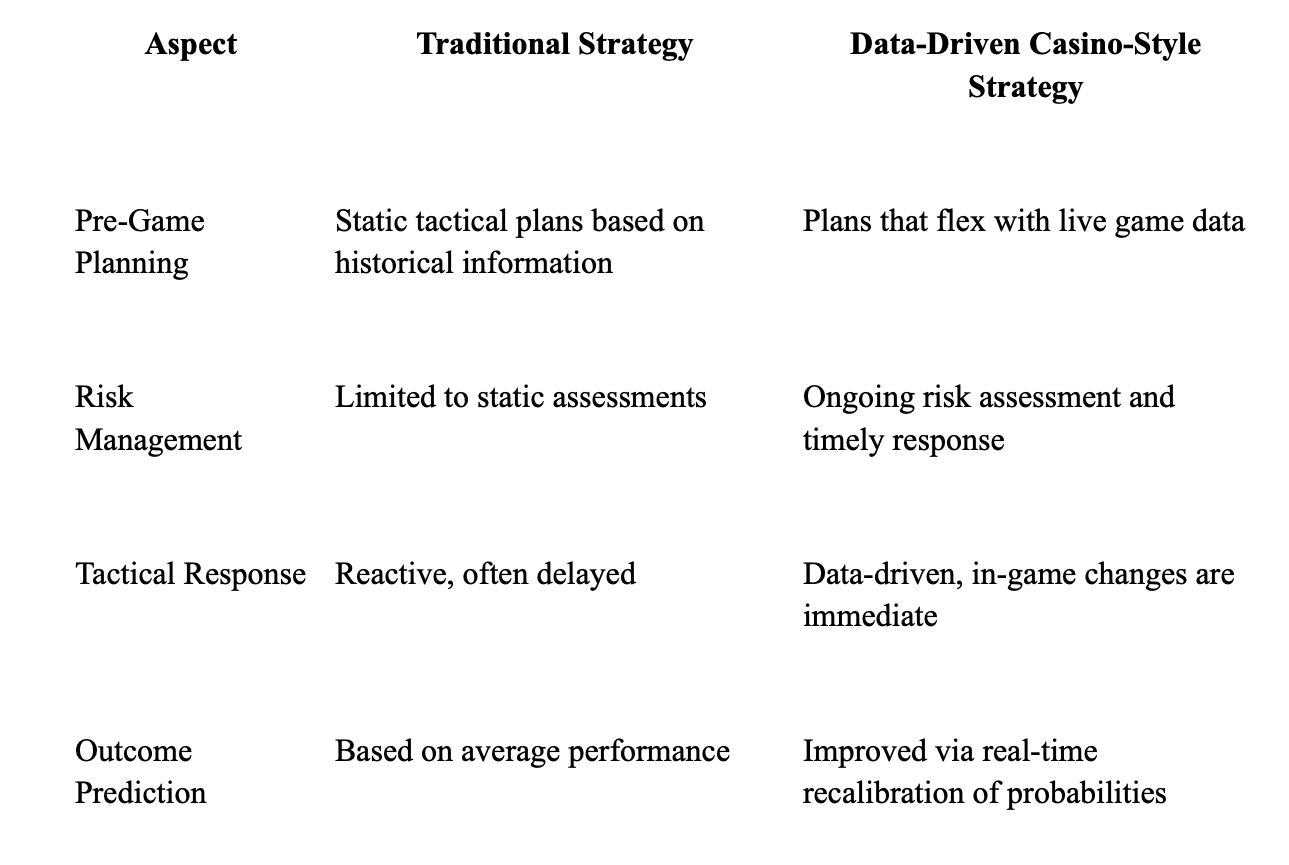
For example, if a team’s defensive line starts to weaken in succession of a string of successful plays by an opponent, a dynamic risk model can suggest an immediate strategy change — like redistributing defensive assignments — that aims to minimize the risk of giving up additional points.
Table 1: Traditional vs Dynamic In-Game Strategy
Maximizing Player Performance and Load Management
There are a lot of factors that influence the athletic performance—physical, psychological, environmental. Casino risk models serve as a basis for such probability monitoring and management of these variables:
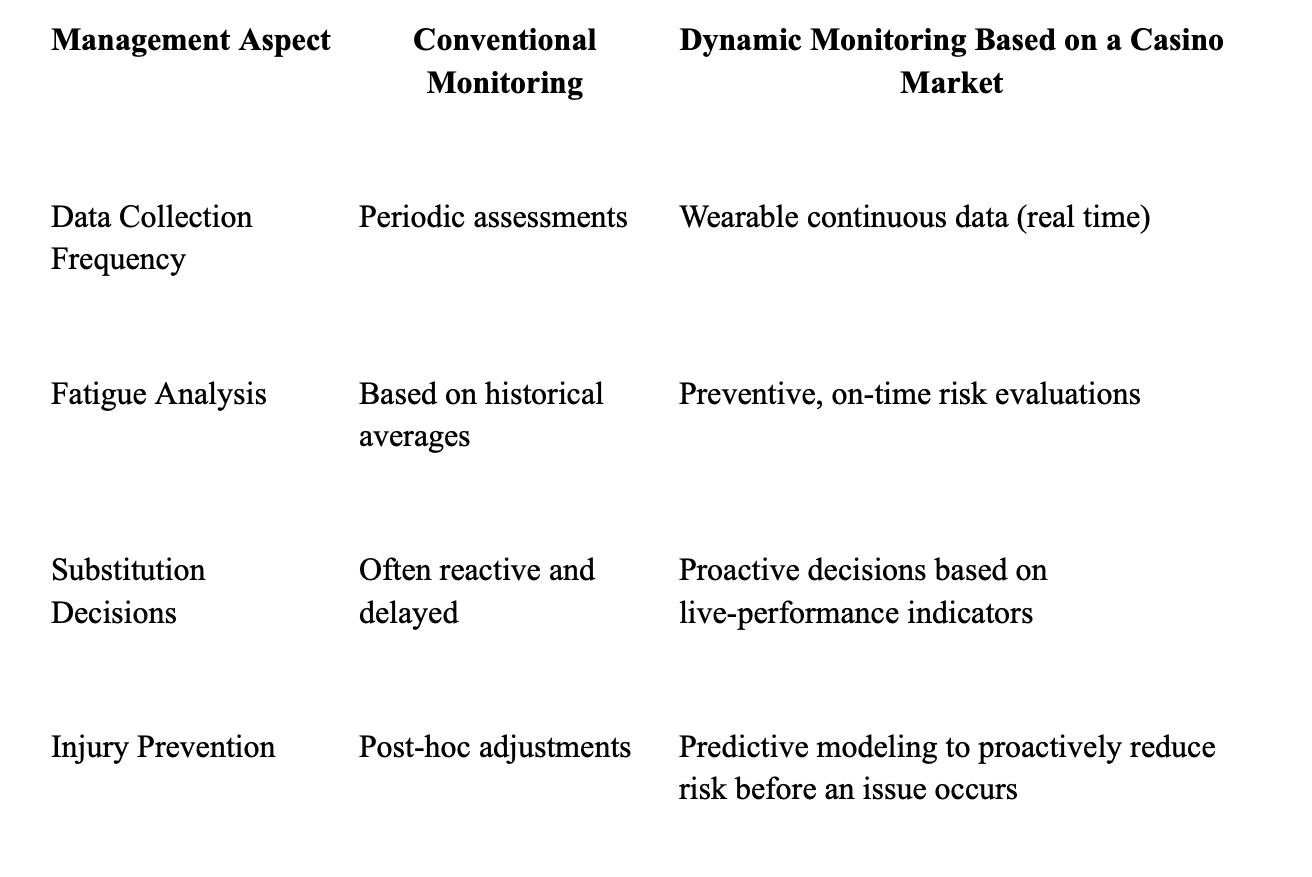
● Continuous Biometric Monitoring: Using wearables for real-time heart rate, speed, and fatigue level tracking.
● Predictive Fatigue Analysis: Using biometric trends to predict performance drops and aid player loads.
● Proactive Substitution Strategies: Data-driven insights on optimal times to rest/sub players, leading to reduced injury risk and maintained optimal performance.
Table 2: Player Performance Management
Improved Scenario Planning and Tactical Forecasting
The power of casino methodologies is the ability to run multiple simulations and scenario plan for a wide range of possibilities. In sports terms, this means:
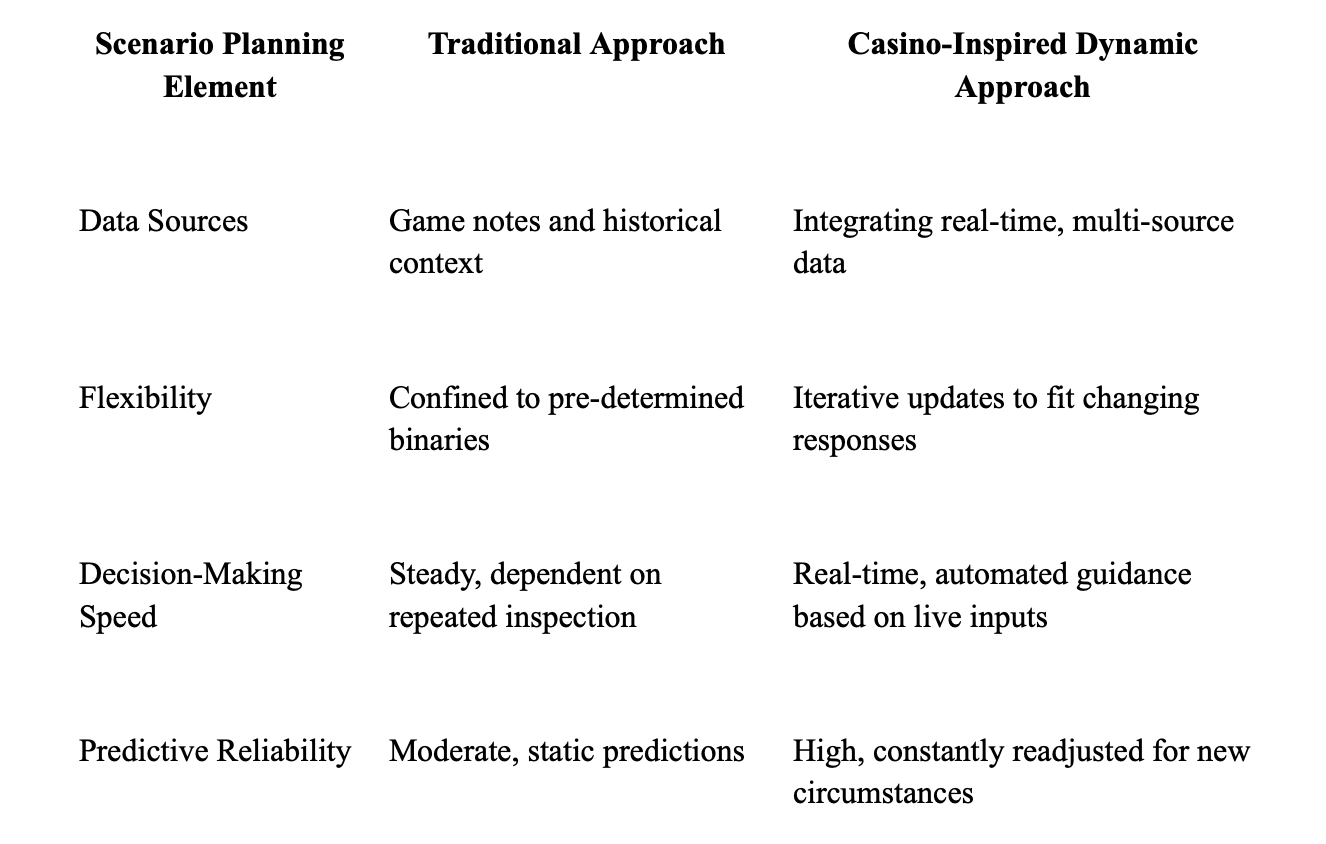
● What-If: Simulating various tactical modifications and surrounding variables.
● Contingency Plan Developing:Create alternate game plans that ultimately can be executed as conditions flow.
● In-Game Forecasting: Real-time models that estimate how tactical changes will impact the game.
Such advanced planning not only leads to prediction accuracy but also prepares teams to handle sudden turn of events during the game.
Table 3: Approaches to Scenario Planning
Big Data and Cloud Computing
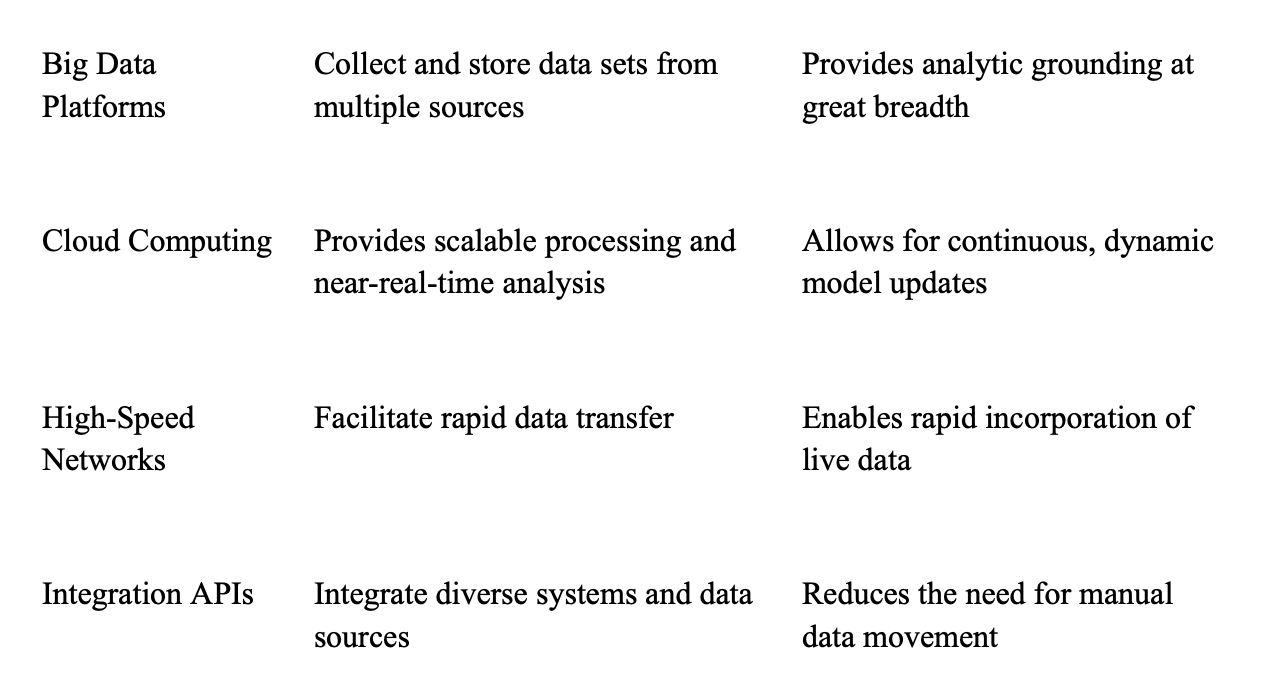
Contemporary sports entities need solid infrastructure to build up their real-time processing and data analytics capabilities on large volumes of data. Big data platforms and cloud computing solutions offer the speed and scalability required for this integration:
● Scalability: The ability to handle a large, complex data set with multi-source data, such as biometric sensors, game logs, and environment data.
● Real-time Processing: With cloud-based solutions, analysis and decisions happen in the moment, allowing models to be always up to date.
● Data Integration: Leave out of the picture different streams of data and serve one well-rounded performance and risk view.
Table 4: Components of the Infrastructure
Component Function Impact on Sports Strategy
Artificial Intelligence & Machine Learning
From AI and machine learning (ML) that power the evolution of dynamic sports strategies through the ability to continuously learn and adapt in real time.
● Adaptive Algorithms: Mechanisms that update predictions continuously as inputs are presented.
● Pattern Recognition: AI is able to facilitate insights that reveal insights between performance metrics that might signal future performance.
● Automated Insights: What do you need to do now to adjust tactically or manage your players per the ML systems?
The technologies that turn raw data into strategic insights that can mean the difference between profit and loss.
The strategic advantages and business-oriented ramifications
Gaining a Competitive Edge
Applying casino data science to sports strategy offers a deep competitive edge for teams:
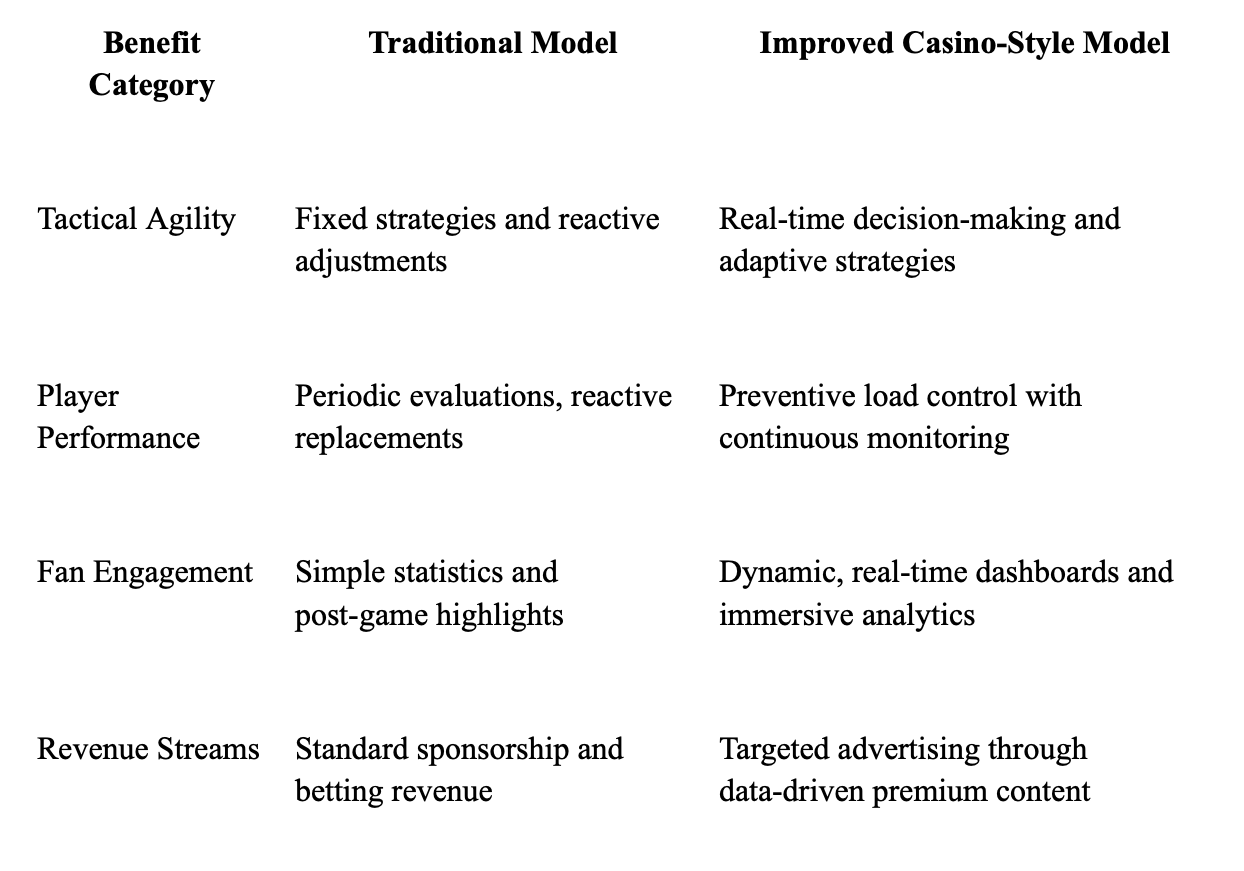
● Increasing Tactical Agility: The teams can respond in real-time to changes in the game, adapting strategies and tactics to counter risks and pursue opportunities.
● Optimal Player Output: With constant monitoring and proactive management of players, we ensure they are at their best and have minimal risk of injury.
● Improving Game Outcomes: With dynamic predictions and scenario crafting, accuracy in forecasting rises, driving success in in-game decision-making.
Commercial and Fan Engagement Benefits
There’s also commercial potential: these types of approaches will unlock huge opportunities off the field, too.
● Interactive Fan Experiences: Live data visualizations and real-time analytics platforms provide immersive experiences that deepen fan engagement.
● Higher Betting Revenue: Accurate and dynamic odds encourage trust in bettors and increase the volume of bets placed.
● Sponsorship and Media Value: Data rich content drives focused opportunities for sponsorship, and increases commercial value in TV rights.
Table 5: Strategic and Commercial Benefits
Data Quality and Standardization
Ensuring Data Integrity And Consistency One of the most prominent challenges Integrating information from different sources requires:
● Stringent Data Governance: Creating norms and methodologies for gathering, cleansing and verifying data.
● Quality Checks Automated: Using the tools that continuously track, and fix, data discrepancies
● Integration without a hitch — Using strong APIs and middleware to bring various streams of information together.
Managing the Complexity for Better Usability
More complex models might be harder to interpret. To ensure usability:
● Easy-To-Use Interfaces: Build dashboards that transform broad analyses into easy to-stage advice.
● Training courses: Create training programs for coaches and analysts to use these tools.
● Iterative Feedback: Regularly adjust systems in light of user input in order to balance sophistication with realistic application.
Professionalism and Compliance with Regulations
There are ethical and regulatory issues around dealing with sensitive player data and real-time analytics:
● Data Privacy: comply with data protection regulations including GDPR, CCPA, etc.;
● Transparency: Ensure that data usage policies are clear to all stakeholders.
● Security Protocols: Use encryption and access controls to secure sensitive data.
New Innovations and Collaborative Possibilities
Artificial Intelligence and Deep Learning of the Future
Sports strategy is a field that can only improve with more developments in AI and deep learning. These technologies will usher in:
● More Precise Predictions: Algorithms that work with multi-dimensional data to make better predictions.
● More In-Depth: Discovering complex patterns that offer a richer perspective of game dynamics.
● Adaptive Systems: Fully autonomous solutions that constantly adjust tactics while being game-play agnostic.
Broadened IoT and Wearable Integration
As IOT devices and wearables continue to develop they will provide even more rich datasets; Providing:
● Detailed performance statistics: Real-time updates on all aspects of player performance.
● Environmental and Contextual Data: Quantifying ambient conditions; weather; noise levels from the crowd; and how poor or good the playing surface was.
● Improved Risk Management: More accurate predictive models that take a greater number of variables into account.
Utilizing Immersive Technologies for Fan Engagement
Augmented reality (AR) and virtual reality (VR) will transform fans’ live sports experiences. Possible future applications include:
● Real-Time Data Overlays: AR systems that display real-time statistics and predictive insights over the playing field.
● Interactive Viewing Experiences: VR platforms enabling fans to engage more in a data-heavy interactive space.
● Tailored Content: Custom analytics dashboards based on fan preferences, leading to increased engagement and monetization.
Facilitating a Collaborative Ecosystem
Such collaboration will shape the next frontier in coupling casino data science with sports strategy. Sports teams, technology providers, academic researchers and betting operators would then be able to defer costs by pooling resources and expertise with an option to:
● Harmonize Best Practices: Create common standards in data collection, model development, and risk management across the industry.
● Exchange Insights and Data —Do so in a collaborative environment to improve innovation and increase predictive accuracy.
● Push Towards Excellence: Utilize diverse experience to polish models and move sports strategy forward.
The alignment of casino data science and sports strategy is a grand evolution in how competition lives in a world full of fans. Technology: With state-of-the-art risk models and real-time data analytics, innovative sports organizations are turning uncertainty into a competitive advantage through improved decision-making processes. This unprecedented combination opens new sources of revenue and fan engagement, offering tactical flexibility and improved performance on the field.
With technology constantly developing, AI, IoT, and immersive experiences will only elevate these benefits. Integrating a casino element in there so that you monetize every play, every decision, every outcome is the future of sports winning formulas.
The redefinition of sports strategy that is enabled by casino data science is not marginal; it is revolutionary and it will reshape competitive advantage. Games-based training can offer a competitive advantage, ushering in powerful changes in how teams will perform.
The sports industry faces significant environmental issues, including a high environmental footprint and carbon emissions. Major venues, like those used for the FIFA 2022 and 2023 World Cup, are under pressure to adopt sustainable practices. This case study highlights an initiative that used renewable energy, solar panels, recycling, and eco-friendly systems to revolutionize sustainability.
Stadiums have traditionally contributed to emissions through inefficient waste management, irrigation, and energy use. Roof designs and landfill dependency further added to the problem, increasing levels of carbon dioxide and greenhouse gases.
The initiative introduced renewable solutions like solar panels to reduce emissions and innovative recycling programs to handle waste effectively. Upgraded irrigation systems saved water, while eco-friendly designs addressed environmental impact.
The initiative cut carbon footprints, with venues reducing carbon dioxide emissions and decreasing landfill waste. Renewable energy efforts positioned the sports industry as a leader in environmental sustainability, proving it’s possible to meet operational demands while protecting the environment.