Erome: Empowering Creators with Privacy and Control in the Digital Age
Imagine a platform where creators keep 90% of their earnings, maintain full ownership of their content, and operate without algorithmic shadows dictating their reach. This isn’t a utopian fantasy—it’s Erome, a rising star in the creator economy. As platforms like OnlyFans and Patreon dominate headlines, Erome quietly disrupts the status quo with a focus on decentralization and creator autonomy. In this deep dive, we’ll explore how Erome works, why it’s gaining traction, and whether it could be the future of digital content sharing.
What is Erome? Redefining Creator Empowerment
Erome isn’t just another content-sharing site. Launched in 2020, it positions itself as a privacy-first, community-driven platform where creators share photos, videos, and live streams directly with their audience. Unlike traditional models, Erome emphasizes:
Decentralized Control: Creators host content on their own servers or preferred cloud services.
Revenue Transparency: A flat 10% fee on earnings (vs. OnlyFans’ 20% or Patreon’s 5–12%).
Anonymity Options: No mandatory real-name policies, appealing to privacy-focused users.
A 2023 Creator Economy Report highlights that 68% of creators prioritize platform fees when choosing where to publish—a gap Erome exploits strategically.
Erome vs. Competitors: Breaking Down the Differences
Let’s compare Erome to giants like OnlyFans, Patreon, and Fansly:
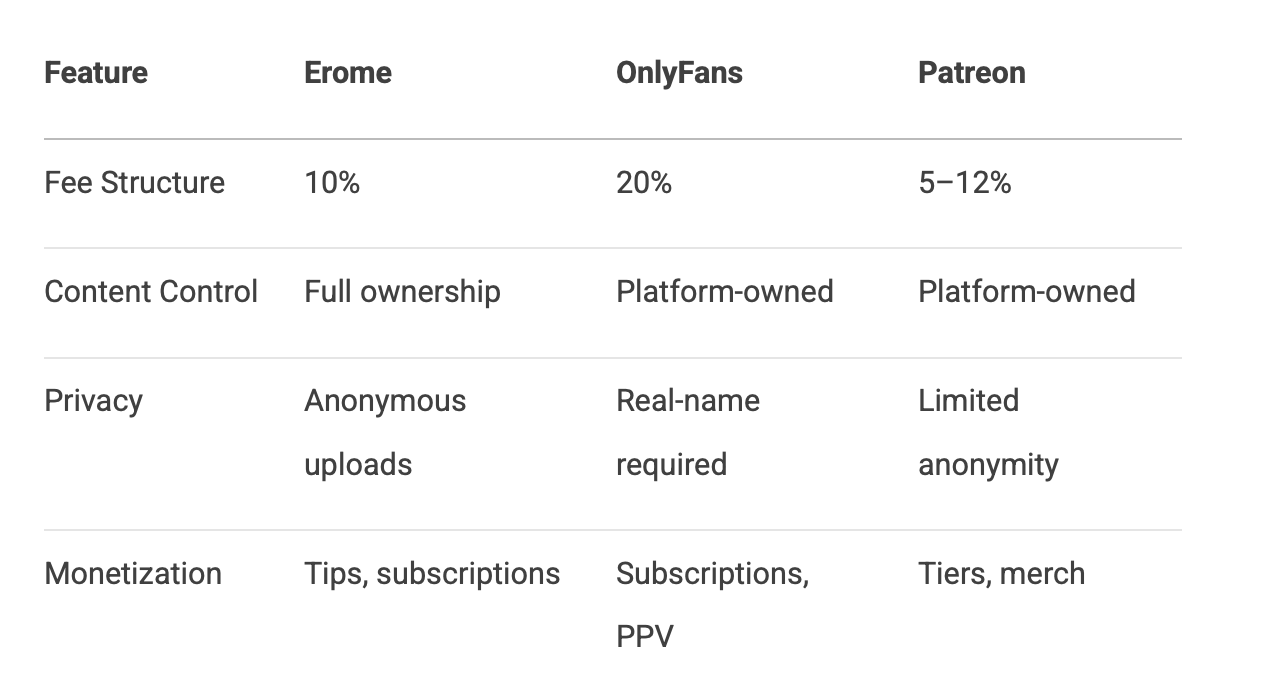
Key Insight: Erome’s decentralized model reduces dependency on platform algorithms, letting creators build direct relationships with fans. However, its smaller user base (est. 500k vs. OnlyFans’ 220M+) poses growth challenges.
Why Creators Are Flocking to Erome
1. Financial Flexibility
Erome’s 90/10 revenue split is a game-changer. For example, indie artist Jenna Cole shared on Reddit that switching from OnlyFans to Erome boosted her monthly income by 40%, despite a smaller audience.
2. Privacy Without Compromise
Erome doesn’t require ID verification for creators, a double-edged sword that appeals to those wary of data leaks but raises concerns about content moderation.
3. Community-Driven Engagement
Creators can organize content into themed “collections” and integrate Discord servers for deeper fan interaction—a feature praised in TechCrunch’s 2023 review of niche platforms.
The Flip Side: Erome’s Challenges
While promising, Erome isn’t perfect:
Discoverability Issues: No built-in recommendation engine means creators must self-promote.
Payment Barriers: Limited to cryptocurrencies and PayPal, excluding regions without access.
Moderation Gaps: Users report sporadic enforcement of content guidelines, risking exposure to harmful material.
A 2024 Pew Research Study notes that 52% of creators prioritize platform safety over revenue—a hurdle for Erome’s expansion.
The Future of Erome: Trends to Watch
Experts predict decentralized platforms will capture 25% of the creator market by 2026 (Forbes, 2023). Erome’s success hinges on:
Scaling Responsibly: Balancing growth with content moderation.
Expanding Payment Options: Adding localized methods like M-Pesa or Pix.
Leveraging Web3: Integrating NFTs or tokenized rewards could attract tech-savvy creators.
Conclusion: Is Erome Right for You?
Erome offers a compelling alternative for creators valuing privacy and financial fairness. While it lacks the reach of giants, its innovative model aligns with the growing demand for decentralized digital spaces.