Maximizing Your Home Workout: Tips for Space and Efficiency
Home workouts that were once performed every now and then have, in recent years, become complete fitness lifestyles. It does not matter whether you are crammed in a small apartment in Patan or in a garage converted into a training space; it is essential to create a convenient and inspirational home gym.
A combination of the space planning, the intelligent choice of equipment, and the planning of the workflow can be the only difference between occasional routine and regular, successful training.
The following guide presents practical and evidence-based tips that can assist you in optimizing your living space for a home workout without undermining the functionality and comfort of the living environment.
The Importance of Space and Efficiency
Home exercises provide space, privacy and convenience. However, the performance and motivation can be compromised by space limitations and disordered equipment.
An organized exercise facility improves:
Workout Flow and Safety: There are clear spaces with sufficient space to move with no interference, creating the least chances of injury.
Motivation and Consistency: A welcoming space is a sign of habit and intent, promoting compliance.
Equipment Longevity: It is ensured that machinery is in proper storage and position to avoid damage and wear.
In cramped quarters, careful design and multi-purpose equipment, e.g. BodyKore trainers and accessories would allow professional-grade exercise without crowding the room. Research shows that properly planned, specific fitness areas enhance compliance with workouts by up to 30%. It is possible to create a smooth progression between exercises and focus on your goals with a conscious plan.
Techniques of Space Streamlined.
Improving home workouts is based on the efficient advantage of physical space. The following are some of the best strategies in order to enhance your environment:
Vertical Storage
Walls are unutilized space. Moving vertical surfaces will release ground areas for movement and stations.
Pegboards and Shelving: Have pegboards over the machines, such as the BodyKore Universal Trainer, to store resistance bands, mats and jump ropes.
Mounted Racks: Fixed-weight storage racks and hooks are used to store dumbbells and accessories off the floor.
Storage: Over-door light gear, e.g. foam rollers and speed ropes, should be stored using above-door brackets.
Vertical storage not only frees floor space but also facilitates easy visibility and access to equipment, thus motivating its use and shortening the time spent on the setup process.
Defined Workout Zones
Divide functional areas to store noise, control the movement, and outline the purpose of workouts:
Rubber Mat Zones: Designate certain mat zones (such as 8 x 10 ft) for squats and pulls, and plyometrics. Mats help keep the floor and make lifts more stable.
Circuit Stations: Trace out cable pull stations, Smith machine exercises, and core work stations to simplify circuits and reduce interruptions.
Make use of visual aids such as colored mats or tape to mark areas, especially in common areas.
Mirrors and Lighting
Mirrors are doubled as they help increase the size of your workout space. They can also provide you real-time form guidance.
Install full-length mirrors on lift stations to check their posture and alignment.
Use the natural light by placing the equipment close to windows. Daylight exposure has the potential to increase energy and mood during exercise.
In areas where there is a lack of natural light, LED lamps reduce dark spots and make spaces welcoming.
Elegant Furniture and Designs
Combining beauty and functionality can boost motivation and productivity:
Storage Ottomans: Storage benches that can be adjusted to seating space offer seating areas and also provide space to store gear.
Foldable Equipment: Select benches and attachments that can be folded against the walls when they are no use.
Minimalist Design: Have open spaces by placing equipment along the peripheral walls instead of placing them in the middle.
Effective Equipment Procurement.
The right equipment will make you train faster and still save on space. The first consideration should be on multi-functional and compact items, which will accommodate as many exercises as possible.
Multi‑Functional Machines
Invest in systems which are not single-purpose:
BodyKore Universal Trainer (MX1174): This can serve as a single-column trainer that provides more than 100 exercises, including cable pulls and functional moves, in a small area.
Essentials BodyKore Dynamic Trainer (MX1161FX): This center offers the sense of working corners and is equipped with pulleys and racks to provide a complete body workout using only 7x7 feet.
The machines are the workhorse of small-space gyms and allow one to perform strength, mobility, and conditioning without any mess.
Foldable and Modular Gear
Adjustable Bench: Select those benches which can be adjusted as flat or tilted to collapse.
Modular Attachments: Purchase quick-change accessories (leg press, dips, landmine) that fit on the main training equipment, avoiding the acquisition of additional equipment.
Roll-Up Mats: The store mats can be kept upright to keep the floor clear.
Taking off single-use equipment, including special leg extension machines, you save space and leave room you add elements of various movement patterns.
Accessory Selection
Small accessories may provide a lot of versatility:
Resistance Bands: Bands are lightweight and portable, and enhance strength and mobility.
Adjustable Dumbbells: Substitute the entire dumbbell racks with the adjustable sets that can be set and re-stored in a short period of time.
Suspension Trainers: Use on ceilings or doors to train with your bodyweight without the use of heavy frames.
Store accessories in wall baskets or bins to reduce clutter.
Gyms at Home of all Sizes.
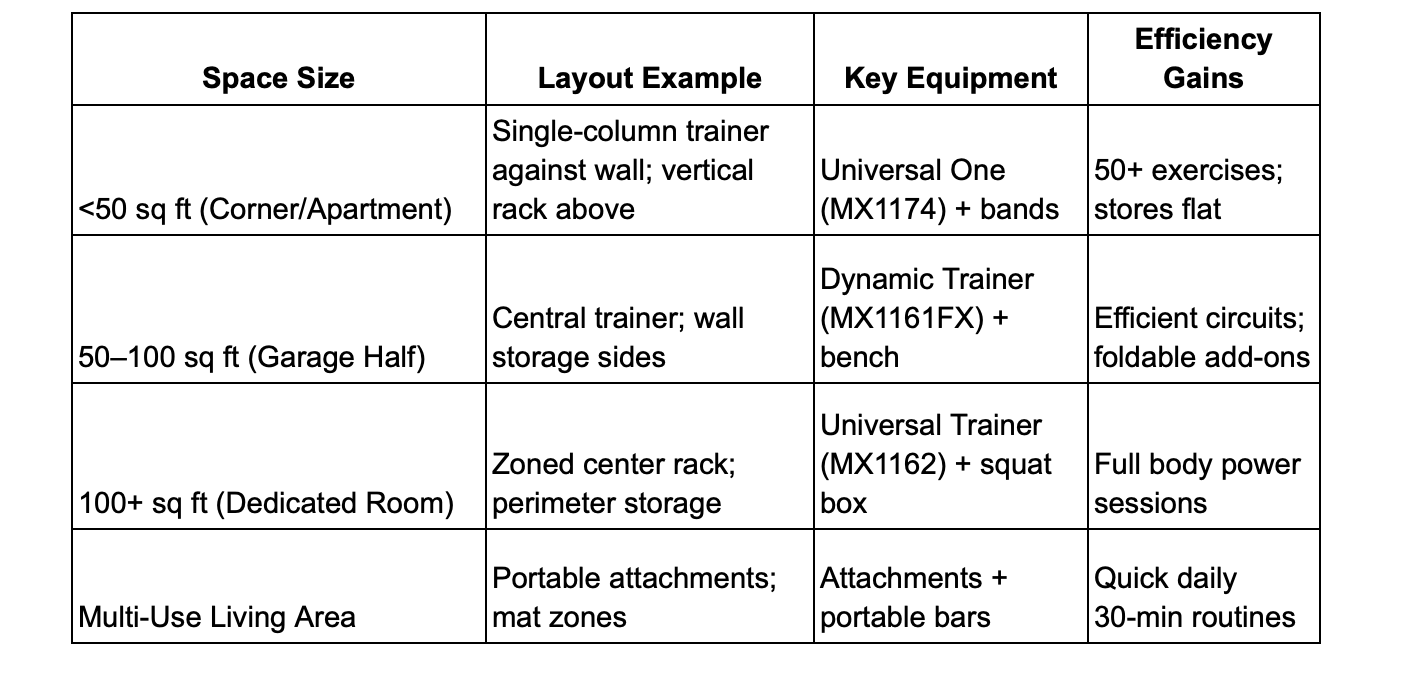
This is because when you know how to organize your space depending on the amount of square footage you have, you can make the most of any situation. The next table provides the practical layout concepts:
Advanced Efficiency Hacks
Split workouts into three points of focus: warm-up, compound lifts, and core finishers so as to have flow and intensity.
Make the lofted pull-up bars or hanging cardio machines. Use high ceilings to make the most of the vertical space.
Temperature (insulating and ventilating areas such as garages) and humidity (exercising in cold weather or damp air) are some of the factors that can make it a comfortable place to work out all year long.
Monitor improvements by using the apps or journals to track the reps, weights and rest times, which should improve consistently.
Periodically inspect and re-arrange equipment positions to enhance flow, ensure safety distance and improve movement efficiency.
Conclusion
It is not just the acquisition of equipment that enables an efficient home gym. It deals with proper planning, prudent use of space and wise organization of workouts. You can get professional-level results even in the smallest space by investing in multi-functional machines, optimizing your layout, and streamlining your workflow.
Regardless of the size of the space you are working in, be it a small apartment or a larger garage, these tips will assist you to remain consistent, achieve maximum productivity and have an inspiring clutter-free workspace. Begin with a clear strategy, work with flexible equipment and change layouts as time goes by, space will be added up, and efficiency will take your home workouts to an even higher level.