Beard Transplant in Turkey: What Men Should Know About Cost, FUE, DHI and Choosing a Clinic
For some men, growing a beard is effortless. For others, facial hair comes in unevenly, leaves visible gaps around the cheeks or jawline, or never develops with the density they would like.
Until relatively recently, there was not much to do about that beyond changing the way the beard was trimmed. Today, beard transplantation has become another option for men who want to improve patchy growth, rebuild areas affected by scars or create a more defined beard and mustache.
Turkey—and Istanbul in particular—has become one of the destinations international patients frequently consider for this type of treatment.
The reasons are familiar: competitive treatment costs, extensive experience with international patients, direct flight connections and an established medical-tourism infrastructure.
But a beard transplant is not simply a smaller version of a scalp hair transplant.
Because the transplanted hairs sit directly on the face, details such as direction, angle, density and beard-line design become especially visible. A procedure can technically succeed while still looking unnatural if those details are poorly planned.
That is why men considering a beard transplant in Turkey should spend as much time researching the design and medical approach as they do comparing prices.
Why Istanbul Attracts Beard Transplant Patients
Turkey's reputation in hair restoration developed primarily around scalp transplantation, but many of the same clinics and medical teams also perform beard and mustache procedures.
For international patients, Istanbul offers a practical advantage: the entire trip can often be organized around a relatively short stay.
Medical tourism providers may coordinate accommodation, airport transfers, local transportation and postoperative appointments in addition to the procedure itself.
Companies such as Este in Turkey operate within this model, combining hair-restoration treatments with support for patients traveling to Istanbul from abroad.
That convenience can make the experience easier.
Still, transportation and hotels should remain secondary considerations.
The most important question is how the beard itself will be planned.
Unlike scalp restoration, where transplanted hair can often blend into surrounding coverage, facial hair is exposed from multiple angles. Small inconsistencies in direction or border design can therefore be much easier to notice.
A Beard Transplant Is Really a Design Procedure
The medical process begins with donor hair.
Follicular units are usually taken from an appropriate donor region—most commonly the back or sides of the scalp—and transplanted into areas of the face where additional growth is desired.
The basic principle sounds simple.
The difficult part is deciding where each graft should go.
A natural beard is not a uniform field of hair. Growth direction changes between the sideburns, cheeks, jaw, chin and mustache. Density also varies from one area to another.
Hair near the cheeks may lie relatively flat against the skin. Around the chin, growth can be thicker and move in a different direction. The mustache introduces another pattern entirely.
A convincing beard transplant needs to respect these changes.
This is why the planning stage matters so much.
The objective should not be to draw a generic beard outline and fill it with the maximum number of grafts. The design needs to match the patient's facial proportions, existing beard growth and preferred grooming style.
Someone who wears short stubble, for example, may notice irregular graft direction more easily than someone who intends to grow a longer beard.
FUE and DHI: What Is the Difference?
Two terms appear repeatedly when researching beard transplantation in Turkey: FUE and DHI.
They are often presented as competing techniques, although the real difference is more nuanced.
FUE Beard Transplant
FUE stands for Follicular Unit Extraction.
Individual follicular units are removed from the donor area rather than taking a strip of tissue. Those grafts can then be transplanted into the beard, mustache, sideburn or goatee area.
In some procedures, clinics use Sapphire FUE, where sapphire blades are used during the creation of recipient channels.
An FUE beard transplant may be considered when a larger facial area needs coverage or when the treatment plan involves rebuilding several sections of the beard.
However, the name of the technique alone does not determine the quality of the outcome.
Extraction pattern, graft handling, recipient-site design and implantation angle are at least as important.
DHI Beard Transplant
DHI, or Direct Hair Implantation, also begins with individually extracted follicular units.
The difference lies mainly in the implantation stage.
A specialized implanter is used to place the grafts, allowing the medical team to control depth, direction and angle during placement.
Those details can be particularly relevant when treating areas where precision matters, such as the mustache, goatee, beard borders or small gaps within existing facial hair.
A DHI beard transplant in Turkey may therefore be recommended in some cases where careful placement between existing hairs is required.
That does not mean DHI is automatically better than FUE.
A man filling two small patches has different needs from someone creating a full beard almost from scratch.
The better technique is the one that fits the individual case.
Patients who want a more detailed overview of the available approaches can read this guide to beard transplant in Turkey, which explains beard and mustache restoration using DHI and Sapphire FUE techniques.
How Many Grafts Does a Beard Transplant Require?
This is one of the first questions many patients ask—and one of the hardest to answer without seeing the beard.
A small patch may require relatively few grafts.
Creating stronger sideburns, connecting a mustache to the beard or adding density to both cheeks can require considerably more.
A full beard reconstruction is a different procedure again.
Existing facial hair also changes the calculation.
If natural beard growth is already present, transplanted follicles may simply need to fill gaps and create continuity. A patient with very little facial hair may need grafts distributed across a much larger area.
For that reason, very large graft numbers should not automatically be viewed as a sign of a better procedure.
Donor hair is finite.
The goal is to use enough grafts to create a convincing result without unnecessarily depleting the donor region.
That becomes particularly important for younger men who may later want scalp hair restoration as well.
How Much Does a Beard Transplant in Turkey Cost?
Cost is naturally part of the decision.
Searches for beard transplant Turkey cost or beard transplant price in Istanbul are common because Turkey is generally chosen partly for its value compared with treatment in the United States, United Kingdom and parts of Western Europe.
But there is no meaningful single price for every beard transplant.
A small gap-filling procedure and a full beard reconstruction are not equivalent.
The final cost may depend on the number of grafts required, the technique used, the medical team, the clinic and the services included in the treatment package.
International patients should therefore look beyond the headline number.
A package may include hotel accommodation, airport transfers, local transportation, medication or postoperative controls.
Another clinic may quote a lower initial price and charge separately for some of those services.
The useful comparison is not simply:
“Which clinic is cheaper?”
It is:
“What exactly am I paying for, and what medical plan am I receiving?”
Transparent pricing usually tells patients more than an unusually low promotional figure.
The Beard Line Should Fit the Face
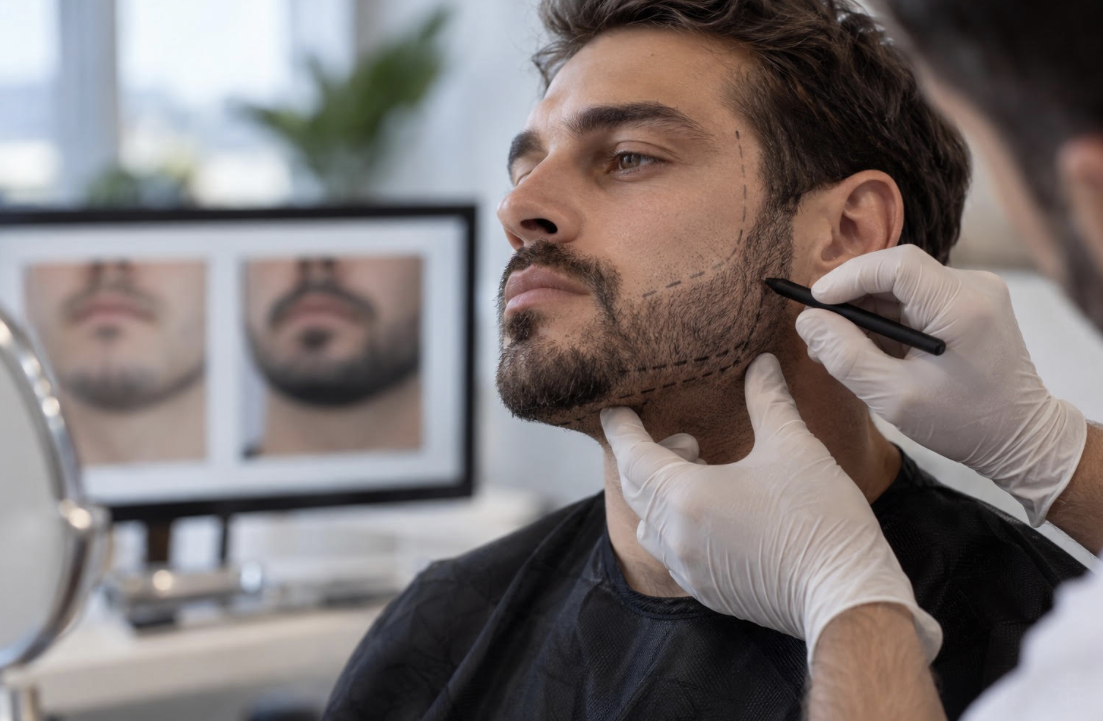
One of the most tempting parts of the consultation is choosing the new beard shape.
It is also one of the easiest places to make a mistake.
A very sharp, perfectly symmetrical beard line may look impressive in a drawing but unnatural once the transplanted hair starts growing.
Natural facial hair usually includes subtle irregularities.
The ideal beard line also varies with the shape of the jaw, cheekbones, chin and existing facial hair.
Some men benefit from a slightly higher cheek line.
Others look better with a more conservative boundary.
The same applies to density.
Maximum density is not necessarily the goal.
A realistic pattern that transitions naturally into existing facial hair often produces a more convincing result than trying to make every square centimeter equally dense.
This is one reason beard-specific before-and-after photographs are more useful than general hair transplant portfolios.
A clinic can be very experienced with scalp procedures while having far less experience with facial-hair design.
Direction May Matter More Than Density
A beard transplant can have excellent growth and still look unnatural.
The reason is usually direction.
Facial hair does not grow straight outward from the skin.
In many areas it lies at a low angle, follows the contour of the face and changes direction gradually.
If transplanted follicles are implanted too vertically, they can appear to stick out from the face even when trimmed short.
That is difficult to hide.
Patients evaluating clinics should therefore look carefully at mature beard transplant results.
Do the transplanted hairs follow the direction of the natural beard?
Does the cheek line look soft or artificially drawn?
Does the mustache blend naturally into the surrounding facial hair?
These details reveal more than simply counting how many grafts were implanted.
What About Patchy Beards and Scars?
Not every beard transplant involves creating a full beard.
Many procedures are much more targeted.
Some men only want to fill areas where natural facial hair grows unevenly.
Others may want to strengthen the connection between the mustache and chin or add density to the sideburns.
Beard transplantation can also be considered in some cases where scars have interrupted normal hair growth.
Scar tissue, however, is different from normal skin.
Its characteristics and blood supply can vary depending on the type and age of the scar.
That means an area affected by scarring should be assessed individually rather than treated like ordinary skin.
Again, this is where a genuine consultation becomes more valuable than a standardized package.
What Is Recovery Like?
The first stage of recovery is visible.
Small crusts can form around newly implanted grafts, and redness may be noticeable for several days.
That is worth considering if the procedure is being combined with a holiday or business trip.
The face is difficult to hide.
Patients need to follow the clinic's postoperative washing and care instructions carefully during this period.
After the initial healing phase, transplanted hairs may shed.
This can be unsettling, particularly for someone who has just traveled abroad for treatment.
But the early appearance is not the final result.
New growth develops gradually over the following months, with density and texture continuing to mature over time.
For that reason, beard transplantation should not be judged by photographs taken only a few weeks after treatment.
Long-term results are far more informative.
Combining Treatment With a Trip to Istanbul
There is an obvious temptation to treat a beard transplant trip like a city break.
Istanbul certainly makes that easy.
A patient arriving early can explore Sultanahmet, walk around Galata, take a Bosphorus cruise or spend time in neighborhoods such as Karaköy before treatment.
After the procedure, however, the priorities change.
Freshly transplanted grafts need protection.
Intensive sightseeing, crowded spaces and unnecessary physical contact with the treated area are less appealing when the face is still healing.
It is therefore sensible to do most sightseeing before the procedure and leave the final part of the trip relatively relaxed.
Patients should also confirm the complete schedule before booking flights.
Ask when the consultation takes place.
Ask when the procedure begins.
Find out whether a postoperative check or first wash is required.
And check when the clinic recommends flying home.
The cheapest flight is not always the most convenient one.
How to Choose a Beard Transplant Clinic in Turkey
Searching online for the best beard transplant clinic in Turkey produces plenty of lists and rankings.
Those can be useful starting points, but they cannot determine which clinic is best suited to an individual patient.
A better approach is to ask specific questions.
Look for beard-specific results, not only scalp hair transplants.
Ask who designs the beard line.
Find out who performs the extraction and implantation stages.
Ask why FUE or DHI has been recommended.
Discuss the proposed number of grafts.
Understand where the donor hair will come from.
Ask what postoperative support is available after returning home.
And pay attention to how the consultation feels.
Does the clinic discuss facial proportions and existing beard growth?
Does it explain why one design may look more natural than another?
Does the treatment plan change according to the patient's face?
Or does every patient seem to receive the same beard outline and the same sales package?
That distinction matters.
Turkey's position in hair restoration has made Istanbul a natural place for men to research beard and mustache transplantation as well.
Competitive costs, direct international travel and a mature medical-tourism sector all contribute to its appeal.
But a beard transplant should not be chosen simply because Turkey offers attractive prices.
The quality of the result depends on much smaller details: hair direction, graft placement, donor management, density, facial proportions and, perhaps most importantly, the design of the beard itself.
Whether the treatment involves FUE, Sapphire FUE or DHI beard transplantation, the technique should serve the patient rather than become the selling point.
Men researching a beard transplant in Turkey should therefore look beyond the biggest graft number and the lowest advertised price.
A successful procedure should not leave people wondering where the beard was transplanted.
Ideally, it should leave them assuming it was always there.