Annapurna Road Conditions: What's Open in October 2026
Annapurna road conditions are improving fast after the late September floods. The Besisahar to Chame road into Manang reopened on 3 October. The Beni to Jomsom road is only partly open, and officials expect it to fully reopen in about a week. The trails themselves are mostly fine. Treks to Annapurna Base Camp, Poon Hill and Mardi Himal are running as normal.
So, what happened?
Late September brought a lot of rain to central Nepal. Between 24 and 27 September, it just kept coming. Rivers rose, hillsides slid, and some of the roads that lead into the Annapurna region took a real beating.
If you have a trek booked this autumn, you probably saw the headlines and felt a little knot in your stomach. That's fair. But here's what most of those headlines didn't make clear: the damage hit the roads, not the high trails.
Our team at Himalaya Guide Nepal checks road status every day with drivers, lodge owners, and guides on the ground. Below is a simple picture as of today. If your dates are coming up soon, message us, and we'll tell you exactly how your route looks this week.
Annapurna Road Conditions For All Trails
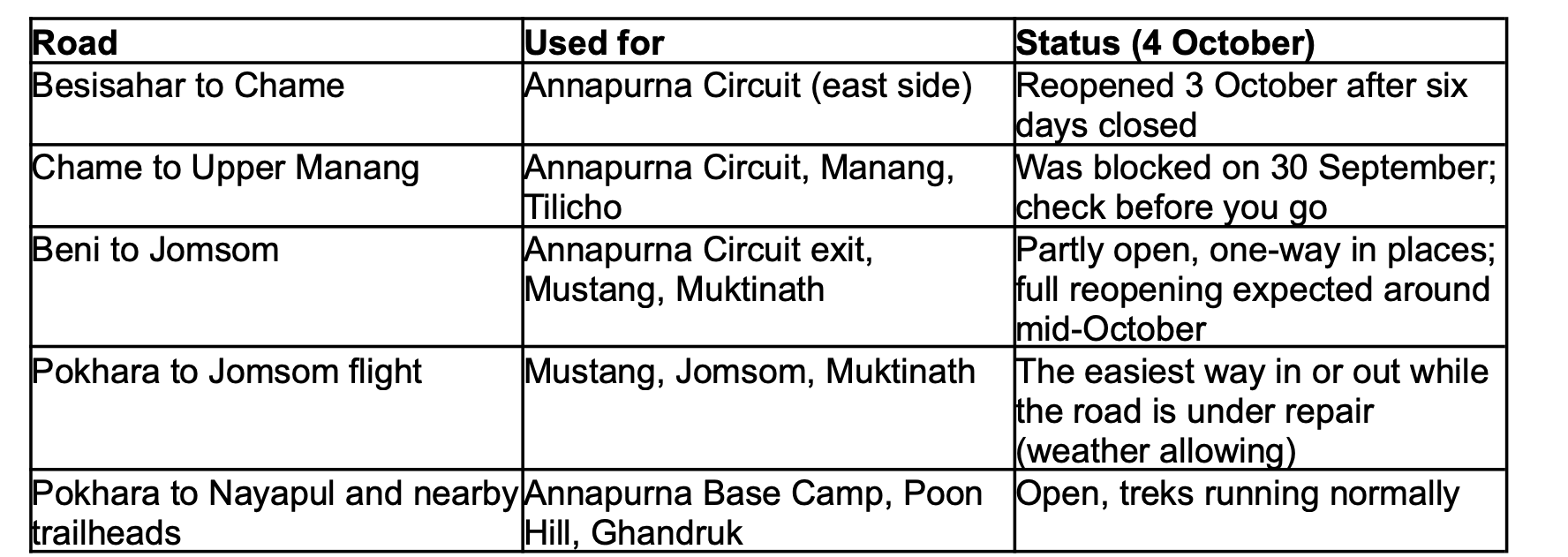
Roads in the hills can change overnight. A road that's open today can have a fresh slide tomorrow, especially if it rains again. So treat this table as a snapshot, not a promise.
East side: Besisahar to Chame and Manang
This is the road most Annapurna Circuit Trek trekkers use to skip the dusty lower valley and start walking higher up.
What went wrong
On 27 September, a flood hit Chame, the district headquarters of Manang. It washed away a few houses and the temporary wooden bridges that vehicles used. Further down, a bigchunk of road around Bagarchhap was lost and landslides blocked the road near Khotro. For a few days, jeeps couldn't get past Rambazar at all.
Where it stands now
The good news landed on 3 October. The Besisahar to Chame road opened again after crews cleared the slides, according to the road project office. Food and supplies are moving back up to Manang, and so are passengers.
The section above Chame toward Upper Manang is the one to watch. On 30 September, local officials said it was basically cut off because a bridge in Chame bazaar was under water. Machines were working on it. We expect it to open soon, but we'll confirm it before
any of our groups head up.
What this means for your trek
Honestly, not much, if you are starting in the second half of October or later. The circuit
above Chame is foot trail anyway. Manang, Thorong La and Muktinath were never on the
road, and the trail up there stayed dry. Manang sits in a rain shadow, so it gets far less rain
than the lower valley.
If you start very soon, give yourself one spare day. A jeep that runs three hours late is
annoying. A jeep that runs three hours late with no buffer day can wreck your acclimatisation
plan.
West side: Beni to Jomsom and Mustang
This road follows the Kali Gandaki river up to Jomsom. Trekkers use it to finish the circuit, and travellers use it to reach Muktinath and Upper Mustang.
The damage
This road got hit harder. Floods and slides damaged it at 46 different points, mostly in the Myagdi section between Maldhunga and Ghasa. One tricky spot near a hydropower project at Tilkenichaur, where the river ate away the old road, has slowed the repairs. A fuel shortage for the machines didn't help either.
Where it stands now
Some parts are already running one-way, including from Tatopani up to Mustang. The road project office said on 3 October that the whole road should open in about seven days, if work goes to plan.
The easy fix: fly
Here's the thing most people forget. The flight from Pokhara to Jomsom takes about 20 minutes. Flights run in the morning, before the wind picks up in the valley. So even with the road out, you can still finish the circuit in Jomsom and fly back to Pokhara, or fly in to start a Mustang trip.
Flights can be delayed by clouds, so we always keep a spare day on that end too.
Annapurna Base Camp, Poon Hill and Mardi Himal
If you're doing one of the shorter treks from Pokhara, you can relax a bit. The Pokhara to Baglung highway lost a short section on 27 September, but it was repaired, and the drives to the usual trailheads are working. Annapurna Base Camp Trek, Ghorepani Poon Hill and Mardi Himal are running normally. The drive from Pokhara to most of these start points takes about 1 to 3 hours, depending on where you begin.
Some of the last stretches are rough dirt roads. Expect bumps, mud in a few spots, and a driver who knows exactly which puddle is deeper than it looks.
What Annapurna roads are like on a normal day
Even without floods, mountain roads in Nepal are not motorways. It helps to know what "road" means up here.
● Kathmandu to Besisahar is about 6 to 7 hours by bus or private jeep, mostly on paved highway.
● Besisahar to Chame is about 4 to 5 hours by jeep on a rough dirt road. It's dusty when dry and muddy when wet.
● Jomsom to Beni and on to Pokhara is a long, bumpy day, which is why many trekkers just fly.
● Local buses are cheap but slow and packed. A shared or private jeep costs more but saves hours.
None of this is a reason to stay home. It's just a reason to plan the transport days properly, the same way you plan the walking days.
Dashain is coming: watch the traffic
Dashain, Nepal's biggest festival, starts on 11 October this year. Millions of people head home to their villages, and many also travel to places like Manang and Mustang for holidays.
That means buses fill up quickly, jeep prices go up, and some services slow down on the main festival days. If your trek starts during Dashain, book your transport early. We usually lock in jeeps for our groups well ahead of the festival so nobody gets stuck at the bus park.
How we handle road problems on our treks
Road trouble is part of trekking in Nepal. What matters is having a plan before it happens. At Himalaya Guide Nepal, we build a spare day into longer itineraries, and we stay in touch with drivers on the main routes so we hear about slides early. If a road closes, we switch to the next best option, whether that's a different start point, a flight, or a changed order of days. Our guides are licensed locals who have dealt with blocked roads many times, so a delay doesn't turn into a panic.
And if a route really isn't safe, we tell you straight. A different trek is always better than a risky one.
FAQ
Is the Annapurna Circuit open right now?
Yes, the trail is open. The Besisahar to Chame road reopened on 3 October. The road aboveChame and the Beni to Jomsom road are still being repaired, so check the latest before you travel.
Can I still reach Jomsom and Muktinath?
Yes. The Pokhara to Jomsom flight is the easiest way while the road is under repair. Parts of the road are already open one-way, and full reopening is expected around mid-October.
Are Annapurna Base Camp and Poon Hill affected?
No. These treks are running as normal. The drives from Pokhara to the trailheads are working.
Should I cancel my October trek?
For most people, no. Just add a buffer day, keep your plans flexible, and travel with a team that checks conditions every day.
Will more rain close the roads again?
It's possible but less likely as the monsoon ends. Once October settles in, rain usually drops off fast and the roads dry out.
Final word
The late September floods were a real mess for the roads, and a much harder time for the families in Chame and along the Kali Gandaki. But Annapurna road conditions are getting better every day, and the trails you came for are still there.
Want a clear answer for your own dates? Send us your plan, and our team at Himalaya Guide Nepal will check the current road status and suggest the smoothest way to get you on the trail.
Sources: road updates reported by Republica and Ratopati (3 October 2026), Khabarhub (3 October 2026) and The Kathmandu Post (28 and 30 September 2026). Conditions change quickly, so please confirm