First-Time Home Buyer Guide: What You Need to Know Before Buying
Buying your first home is exciting, but a First-Time Home Buyer Guide: What You Need to Know Before Buying can make the process much easier to understand. From checking your credit and choosing a mortgage to budgeting for closing costs and making an offer, each decision can affect your long term finances.
The most important point is simple: a first time home buyer should determine what they can comfortably afford before deciding which house to buy. Your approval amount is not necessarily the same as a comfortable monthly payment.
For example, a buyer who qualifies for a $400,000 mortgage may decide that a $325,000 home makes more financial sense after accounting for taxes, insurance, maintenance, utilities, and other monthly obligations. That difference can provide valuable breathing room after closing.
This guide explains the home buying process from preparation through closing, with practical information about mortgage options, down payments, credit, inspections, assistance programs, and common mistakes.
What Should a First-Time Home Buyer Do First?
The first step is not touring houses. It is understanding your financial position.
Before contacting a real estate agent or making an offer, review these five areas:
Income: Determine how much reliable monthly income you have.
Credit: Review your credit reports and scores for errors or issues.
Debt: Calculate your existing monthly debt payments.
Savings: Identify funds available for the down payment, closing costs, reserves, and moving expenses.
Monthly budget: Decide what mortgage payment fits comfortably within your lifestyle.
HUD recommends that prospective buyers consider income, credit, existing expenses, down payment, and interest rates when determining affordability. HUD also recommends exploring housing counseling and homebuying programs available in your state.
Check Your Credit Before Applying
Your credit profile can influence the mortgage programs and pricing available to you. Before applying, check your credit reports for inaccurate accounts, incorrect balances, or outdated information.
Do not open several new credit accounts simply because you are preparing to buy a house. Major changes to your finances can create additional questions during mortgage underwriting.
If your credit needs work, ask a qualified mortgage professional what changes could improve your financing options before you start shopping.
Build a Complete Home Buying Budget
Your budget should include more than principal and interest.
Potential housing expenses include:
Principal and interest
Property taxes
Homeowners insurance
Mortgage insurance when applicable
HOA dues
Utilities
Maintenance and repairs
Closing costs
Initial furniture or appliance expenses
A mortgage payment that looks affordable on paper can become uncomfortable when these additional costs are added.
How Much Money Does a First-Time Home Buyer Need?
One of the biggest misconceptions about buying a home is that you always need 20% down.
That is not true.
The required cash depends on the loan program, borrower qualifications, property, purchase price, and applicable assistance programs. Some qualified buyers may use low down payment programs, while eligible veterans and certain rural homebuyers may qualify for programs with no down payment.
FHA Loans
FHA financing can be useful for many first time buyers because qualified borrowers may be able to make a down payment as low as 3.5%. FHA loans are insured by the Federal Housing Administration, which is part of HUD.
FHA financing can be especially worth discussing when a buyer wants a lower down payment or has a credit profile that may not fit every conventional option.
However, buyers should also understand mortgage insurance costs and compare the total long term cost with other loan programs.
Conventional Loans
Conventional mortgages are not insured by the federal government. Some conventional programs allow relatively low down payments for qualified borrowers.
A conventional loan may be attractive when a buyer has strong credit, stable income, and enough savings to meet the program requirements.
The right choice is not simply the loan with the lowest down payment. Compare the interest rate, mortgage insurance, closing costs, monthly payment, and expected time in the home.
VA Loans
Eligible veterans, active duty service members, and some surviving spouses may qualify for VA backed financing.
A VA purchase loan can offer no down payment for eligible borrowers when program requirements are met. VA backed loans also do not require monthly private mortgage insurance. Eligibility requires a Certificate of Eligibility and satisfaction of lender requirements for credit, income, and other factors.
For eligible first time buyers, the VA loan benefit can be one of the most powerful financing options available.
USDA Loans
USDA's Single Family Housing Guaranteed Loan Program can provide 100% financing for eligible borrowers purchasing an eligible property in a qualifying rural area. Income and property eligibility requirements apply.
This makes USDA financing worth investigating for buyers who are open to locations outside major urban centers.
What Mortgage Should a First-Time Home Buyer Choose?
There is no single best mortgage for every buyer.
The right mortgage depends on your financial profile, eligibility, purchase price, location, savings, and long term plans.
A useful comparison looks like this:
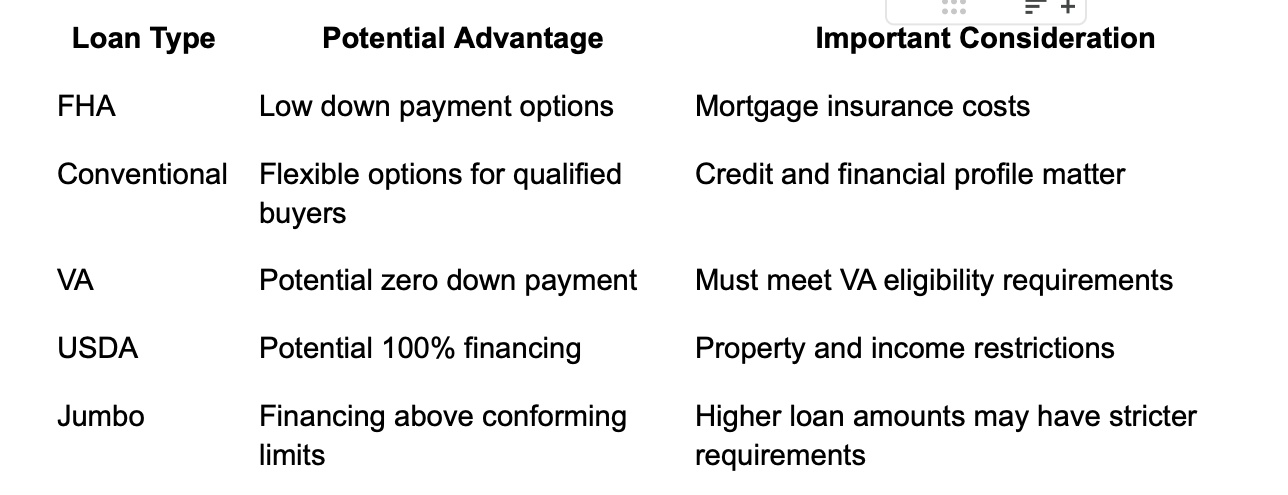
In 2026, the baseline conforming loan limit for a one unit property is $832,750, while high cost areas can have higher limits.
That matters because the loan amount and location can determine whether a mortgage is considered conforming or requires a different financing strategy.
Compare More Than the Interest Rate
When comparing lenders, look beyond the advertised rate.
Review:
Interest rate
Annual percentage rate
Loan term
Points
Lender fees
Mortgage insurance
Estimated taxes and insurance
Closing costs
Cash required to close
Whether the rate is fixed or adjustable
The CFPB explains that the Loan Estimate provides standardized information that helps consumers compare mortgage offers.
What Are the Costs of Buying a Home?
The down payment is only one part of the cash needed to purchase a property.
Closing Costs
Closing costs can include lender charges, title related expenses, recording fees, prepaid expenses, taxes, insurance, and other transaction costs.
Your exact amount depends on the transaction.
This is why a buyer should ask the lender for a detailed estimate rather than assuming that the down payment represents the total cash requirement.
Prepaid Expenses and Escrow
Some buyers are surprised by prepaid taxes and insurance or initial escrow deposits.
These amounts are not necessarily lender fees. They can be amounts collected at closing to establish or fund an escrow account for future property taxes and insurance.
Home Inspection
A home inspection is another important expense to consider.
An inspection can identify problems involving the roof, foundation, electrical system, plumbing, HVAC, moisture, or other components of the property.
A home inspection does not guarantee that a property has no problems. Instead, it gives the buyer additional information before completing the purchase.
HUD includes getting a home inspection as an important part of the home buying process.
What First-Time Home Buyer Programs Are Available?
First time buyers should investigate programs beyond the mortgage itself.
Potential assistance can come from:
State housing finance agencies
Local government programs
Down payment assistance programs
Grants or forgivable assistance, where available
Employer assistance programs
Housing counseling agencies
Special federal housing programs
Eligibility varies significantly by location and program.
HUD notes that state and local governments may offer programs that help with down payments and encourages buyers to investigate available assistance.
Do Not Assume You Need Perfect Credit
Another common mistake is assuming that you must have perfect credit before buying.
Mortgage requirements vary by loan type and lender. A buyer with less than perfect credit may still have financing options.
The smarter approach is to understand the complete picture:
Credit + income + debt + assets + property + loan program = overall mortgage qualification.
That is why comparing several potential loan options can be more useful than focusing on a single credit score number.
What Is the First-Time Home Buying Process?
The process can be simplified into several major stages.
Step 1: Review Your Finances
Check your credit, income, debt, savings, and monthly budget.
Step 2: Explore Mortgage Options
Compare FHA, conventional, VA, USDA, and other appropriate financing options.
Step 3: Get Preapproved
A preapproval can help you understand your potential buying range and can make your offer more credible.
However, remember that a preapproval is not a guarantee that every property or loan will ultimately be approved.
Step 4: Find a Home
Once your financing and budget are clear, work with a qualified real estate professional to identify suitable properties.
Step 5: Make an Offer
Your offer may include the purchase price, financing terms, inspection provisions, closing timeline, and other contingencies.
Step 6: Complete the Inspection and Appraisal
The inspection evaluates the property's condition. The appraisal provides an independent opinion of value for the lender.
These are different processes and serve different purposes.
Step 7: Complete Underwriting
The lender verifies financial information, documentation, property details, and other requirements before issuing final approval.
Step 8: Review Your Closing Disclosure
The CFPB requires the lender to provide a Closing Disclosure at least three business days before closing for covered mortgage transactions. It shows final loan terms, projected payments, closing costs, and other transaction details.
Compare the Closing Disclosure with your earlier Loan Estimate. If something changed, ask your lender or settlement agent why.
Step 9: Close and Become a Homeowner
At closing, you sign the required documents and provide the funds required to complete the transaction. Once the transaction is completed according to applicable state procedures, ownership transfers to you.
What Mistakes Should First-Time Home Buyers Avoid?
A first time home buyer can reduce unnecessary stress by avoiding these common mistakes.
Buying Based Only on the Maximum Approval
Your lender may approve you for more than you actually want to spend.
Choose a payment that leaves room for emergencies, repairs, savings, travel, family expenses, and other priorities.
Using Every Dollar for the Down Payment
Putting more money down can reduce the loan balance, but draining your savings can leave you vulnerable after closing.
A home needs maintenance. Appliances break. Insurance deductibles exist. Unexpected expenses happen.
Ignoring Property Taxes and Insurance
Two homes with identical purchase prices can have very different monthly costs because taxes, insurance, HOA fees, and local expenses vary.
Making Major Financial Changes Before Closing
Avoid unnecessary new debt or major unexplained financial changes during the mortgage process unless you have discussed them with your lender.
Choosing a Mortgage Without Comparing Offers
Even a small difference in fees or loan terms can affect the total cost of borrowing.
The CFPB's mortgage resources are designed to help consumers compare offers and understand the Loan Estimate and Closing Disclosure.
A Practical First-Time Home Buyer Checklist
Before making an offer, ask yourself:
Have I reviewed my credit?
Do I know my monthly debt obligations?
Have I established a realistic home buying budget?
Do I have funds for the down payment?
Have I budgeted for closing costs?
Do I have money left for emergencies?
Have I compared mortgage options?
Have I received a preapproval?
Have I researched down payment assistance?
Have I considered property taxes and homeowners insurance?
Have I reviewed the home's condition?
Have I planned for maintenance?
Do I understand the terms of my mortgage?
If several answers are "no," take time to prepare before rushing into a purchase.
Final Thoughts: How Should You Prepare to Buy Your First Home?
Buying your first home becomes easier when you treat the process as a financial decision rather than simply a house hunt.
Start with your budget. Review your credit and debt. Compare mortgage options. Investigate assistance programs. Get preapproved. Then shop for a property that fits your finances instead of stretching your budget simply because a lender says you qualify.
A strong first time home buyer strategy is not about finding the biggest mortgage you can obtain. It is about finding a home and loan combination that you can manage comfortably over time.
For personalized guidance, speak with a qualified mortgage professional who can review your situation and explain which loan programs may fit your goals.
About Duane Buziak: Duane Buziak, Mortgage Maestro, NMLS #1110647, is a licensed mortgage broker with Coast2Coast Mortgage LLC. He serves borrowers in Virginia, Florida, Tennessee, Georgia, Washington, D.C., North Carolina, South Carolina, and Maryland, specializing in VA home loans and first time homebuyer programs.
First-Time Home Buyer FAQ
1. What is the first step for a first-time home buyer?
The first step is to review your finances. Check your credit, income, monthly debts, savings, and realistic housing budget before choosing a property.
2. How much should a first-time home buyer put down?
The required down payment depends on the mortgage program and borrower qualifications. Some FHA borrowers may qualify for 3.5% down, while eligible VA and USDA borrowers may qualify for financing with no down payment.
3. What credit score do I need to buy my first home?
There is no single credit score requirement for every mortgage. Requirements vary by loan program and lender. Your credit history, income, debt, assets, and other factors are also considered.
4. Should first-time buyers get preapproved?
Yes. A mortgage preapproval can help you understand your potential buying range before you make an offer. It can also help you identify financing issues early in the process.
5. What are closing costs when buying a home?
Closing costs are expenses associated with completing the mortgage and real estate transaction. They can include lender charges, title expenses, recording fees, prepaid taxes, insurance, and other costs.
6. Can first-time home buyers get down payment assistance?
Potentially. State and local governments, housing agencies, and other organizations may offer programs for eligible buyers. Requirements vary by location, income, property, and program.