

Understanding Your Rights: Drug and Alcohol Testing at Work
A workplace drug or alcohol test can feel confronting, especially when you are unsure why you have been asked to take one or what happens to the result. The important thing to know is that drug and alcohol testing at work is not simply about catching people out. In certain Australian workplaces, testing forms part of a broader approach to managing safety risks.
Your rights depend on your industry, employment arrangements, workplace policy, contract and applicable laws. Employers also need to ensure that any testing requirement is lawful and reasonable and that workplace health and safety obligations are met.
Here is what Australian workers should know before agreeing to a test.
You Should Know Why Testing is Required
Before participating in workplace drug and alcohol testing, it is reasonable to understand what the employer's policy requires and how the process operates.
Look for information about:
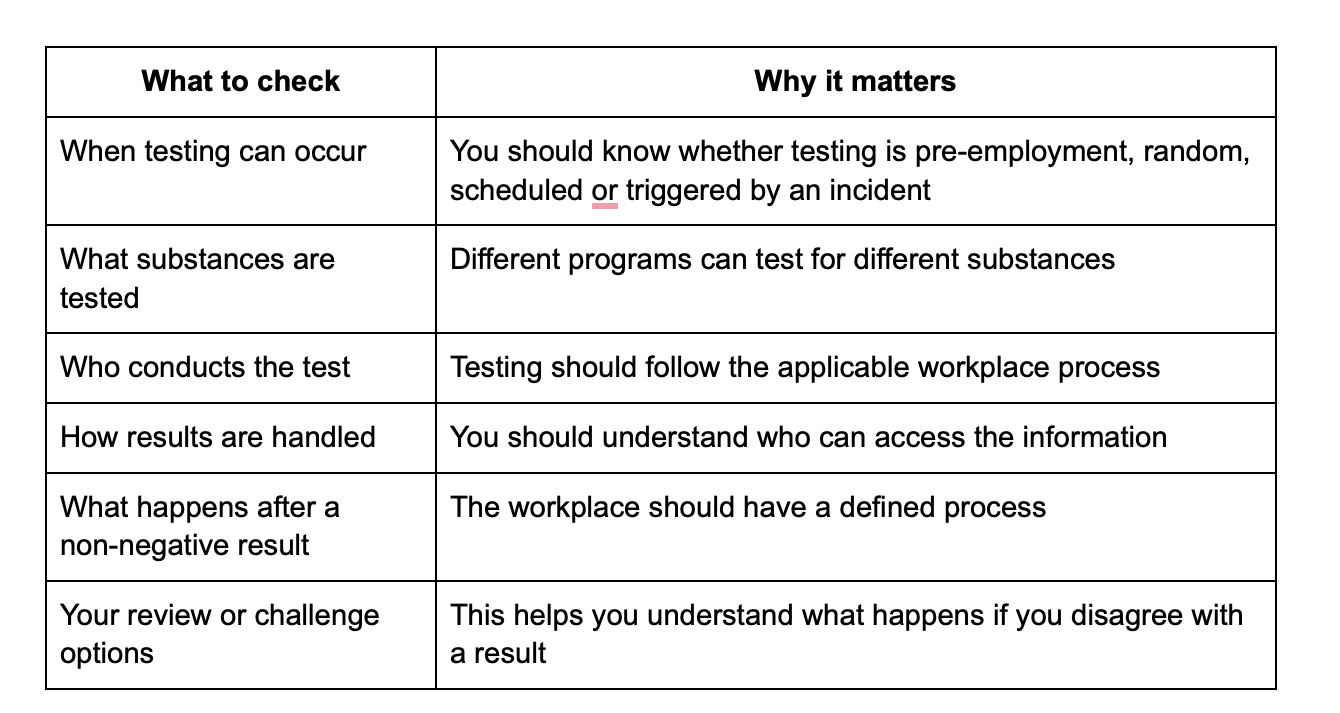
If you have not been given the relevant workplace policy, ask for it. That simple step can help you understand your obligations before a test takes place.
Workplace Policies Should Explain When Testing Can Happen
Testing arrangements can vary considerably between workplaces. For example, an employer may have provisions covering:
Pre-employment testing
Random testing
Testing after a workplace incident
Testing where there is reasonable concern about impairment
Return-to-work testing
Follow-up testing under a workplace policy
Do not assume that a test is random simply because you were not expecting it.
Your employment contract, workplace policy, enterprise agreement and applicable legislation may all influence what your employer can require. If you are uncertain about your rights, obtain advice specific to your circumstances rather than relying on general information.
Privacy Matters When Medical or Testing Information is Collected
Drug and alcohol testing can involve sensitive personal information. Workers may reasonably want to know who sees their results, where records are stored and how long information is retained. Privacy obligations can vary depending on the organisation and circumstances, so there is no single privacy rule that applies identically to every workplace.
Ask practical questions such as:
Who receives the result?
Is the result stored in my personnel record?
Who can access it?
How is the information protected?
Will the result be provided to anyone outside the organisation?
Getting clear answers can remove unnecessary uncertainty.
Drug and Alcohol Testing Should Form Part of a Wider Safety System
Testing alone does not create a safe workplace. Safe Work Australia emphasises that employers must manage health and safety risks, while workers have responsibilities to take reasonable care of their own health and safety and that of others.
A stronger workplace approach can include:
Clear drug and alcohol policies
Worker consultation
Education about impairment
Appropriate supervision
Safe work procedures
Access to support where appropriate
Risk controls for safety-critical tasks
This matters because impairment can be only one part of a much larger workplace risk picture.
What Should You Do If You Are Asked to Take a Rest?
You do not need to panic. Start by understanding the process.
1. Ask why the test is required.
Find out whether it is part of your contract, workplace policy, industry requirement or another process.
2. Ask what type of test will be conducted.
Understand what the test is designed to detect.
3. Read the relevant workplace policy.
Check when testing can occur and what happens after a result.
4. Tell the appropriate person about relevant medication if required.
Do not stop prescribed medication simply because you are concerned about testing. Speak with your healthcare professional first.
5. Ask how your information will be handled.
Understand who will receive and store the result.
6. Seek advice if something does not seem right.
A union, workplace representative, legal professional or relevant regulator may be able to explain your options.
Drug and Alcohol Testing is About Safety, But Your Rights Still Matter
The safest approach is to understand both sides of the issue. Employers have duties to manage workplace health and safety risks. Employees have responsibilities to remain fit for work and avoid putting themselves or others at risk.
If you are asked to undergo drug and alcohol testing, knowing why it is happening, what the process involves and how your information will be handled can make the experience much less stressful.
The rules can differ significantly between industries and jurisdictions, so treat general information as a starting point rather than legal advice. For workplace-specific concerns, check the relevant state or territory regulation guide for current guidance.