7 GPS Tracking Devices for Family Trips
Family trips often involve managing multiple moving parts, including people, luggage, and vehicles. GPS tracking devices help simplify this by providing location visibility during travel, whether you're monitoring a child in a crowded area, tracking bags at an airport, or keeping an eye on a vehicle during a road trip.
Different types of trackers serve different purposes. Real-time GPS trackers are designed for continuous location monitoring, making them suitable for children, seniors, and vehicles, while Bluetooth-based trackers work better for locating personal items like luggage and backpacks within a limited range.
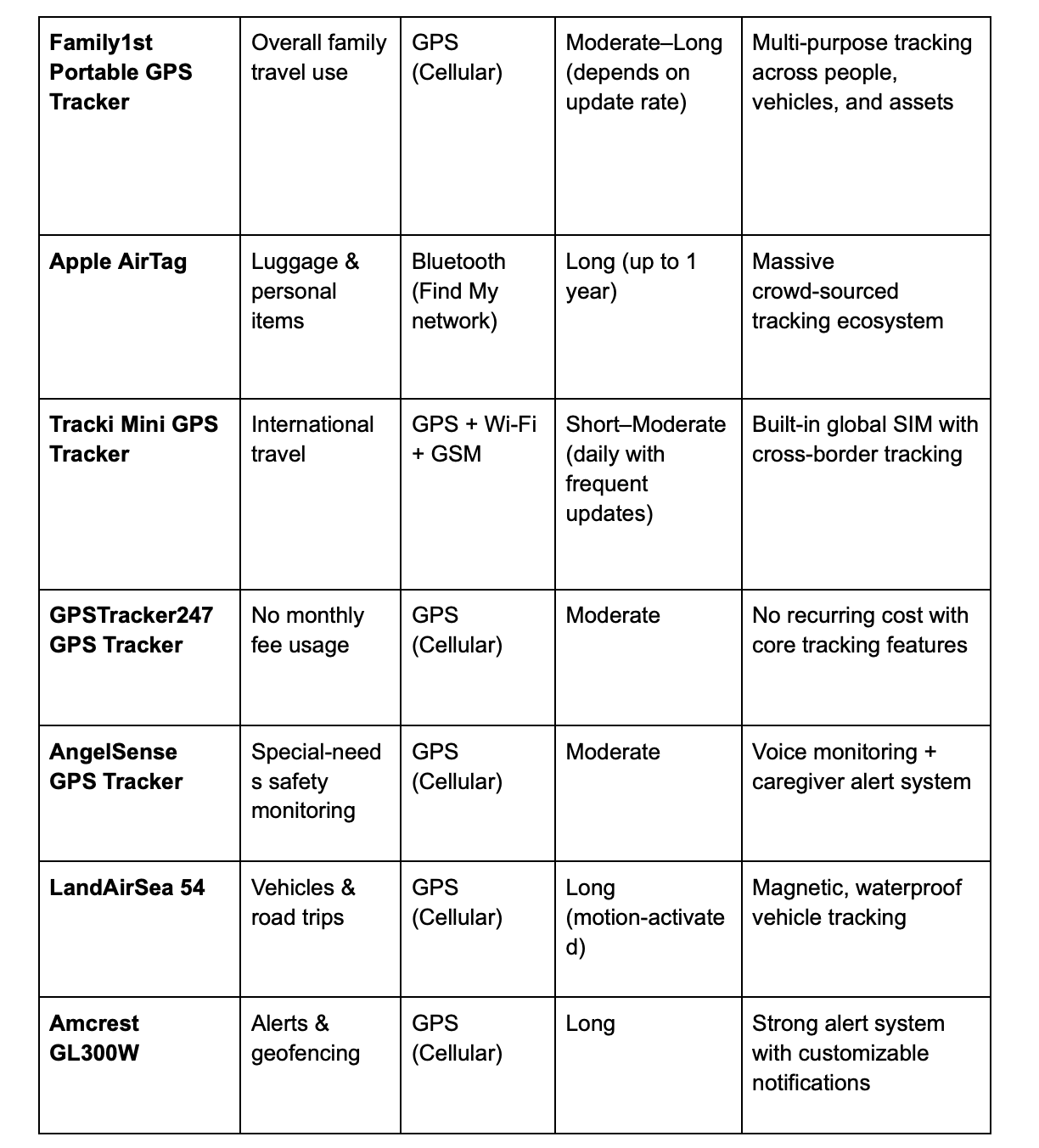
Choosing the right device depends on how you plan to use it, where you are traveling, and how frequently you need location updates. List below compares the top GPS tracking devices for family trips based on real-world use cases such as safety monitoring, international travel, and cost efficiency.
What Are the Top 7 GPS Tracking Devices for Family Trips?
1. Family1st Portable GPS Tracker : Best Overall Family Travel Tracker
Family1st Portable GPS Tracker stands out as the most balanced device for family trips because it supports multiple tracking scenarios in one system. Coverage extends across children, vehicles, and travel belongings without requiring separate tools.
Live updates, geofencing alerts, and route history create a reliable monitoring system for both safety and coordination during travel. A single dashboard simplifies tracking across different family members and assets.
Key Features
Live GPS tracking with mobile app
Geofencing and movement alerts
Location history and trip playback
Compact and portable design
Multi-use tracking capability
Limitation
Faster update intervals reduce battery life and require more frequent charging on long travel days.
2. Apple AirTag : Object and Luggage Recovery Tracker
Apple AirTag focuses on tracking personal belongings such as luggage, backpacks, and travel essentials. Integration with the Find My network allows location updates through nearby Apple devices rather than direct GPS transmission.
Crowded environments like airports and hotels make AirTag especially effective due to its large device network. Precision Finding further improves accuracy for short-range recovery.
Key Features
No subscription required
Precision Finding support
Global crowd-sourced tracking
Replaceable battery (up to 1 year)
Limitation
Lacks real-time tracking for people or moving vehicles.
3. Tracki Mini GPS Tracker : Worldwide Travel GPS Tracker
Tracki Mini GPS Tracker delivers consistent tracking across international locations thanks to its built-in global SIM support. Travelers moving between countries benefit from uninterrupted tracking without switching networks.
Compact size combined with multi-network connectivity makes it adaptable for luggage, children, and vehicles. Flexibility remains its strongest advantage during global trips.
Key Features
Worldwide coverage with global SIM
Tracking with adjustable intervals
Portable and lightweight design
Multi-use tracking support
Limitation
Battery drains faster under continuous real-time tracking.
4. GPSTracker247 Real-time GPS Tracker with No-Monthly-Fee
GPSTracker247 differentiates itself by removing recurring subscription costs while still offering core GPS tracking functionality. Budget-conscious travelers benefit from predictable expenses without long-term commitments.
Essential features such as real-time tracking, geofencing, and route history remain available despite the no-fee model. Simplicity makes it suitable for occasional travel use.
Key Features
No monthly subscription required
Live location tracking
Geofencing alerts
Historical route playback
Limitation
Advanced analytics and premium features are more limited compared to subscription-based systems.
5. AngelSense GPS Tracker : Special-Needs Safety and Monitoring Tracker
AngelSense focuses on families requiring enhanced safety monitoring, particularly for children or individuals with special needs. Built-in communication tools and proactive alerts provide an additional layer of protection.
Voice monitoring, SOS alerts, and continuous tracking make it suitable for high-risk travel scenarios. Caregiver-focused design separates it from general-purpose trackers.
Key Features
SOS emergency alerts
Two-way voice communication
Real-time location updates
Designed for special-needs care
Limitation
Larger size and wearable design make it more noticeable than smaller portable trackers
6. LandAirSea 54 : Magnetic Waterproof Vehicle Tracker
LandAirSea 54 is engineered for vehicle tracking during road trips, offering a durable and discreet tracking solution. Strong magnetic mounting allows secure placement without visible installation.
Motion-activated tracking helps preserve battery while still delivering accurate updates when movement occurs. Rugged construction ensures reliability in outdoor conditions.
Key Features:
Magnetic mount for easy attachment
Waterproof and durable design
Motion-activated tracking
Long battery life
Limitation
Placement under heavy metal surfaces can weaken signal strength and reduce tracking accuracy.
7. Amcrest GL300W : Geofencing and Alert-Focused GPS Tracker
Amcrest GL300W prioritizes alerts and notifications, making it useful for families who want live updates on movement and boundaries. Custom geofencing ensures instant alerts when predefined zones are crossed.
Multiple notification channels improve visibility during travel, especially in unfamiliar locations. Strong alert systems enhance safety awareness.
Key Features:
Real-time GPS tracking
Geofencing and instant alerts
SOS notifications
Long battery life
Limitation
Alert setup can take longer for first-time users because of its wider notification settings.
How Do These GPS Tracking Devices Compare for Family Trips?

Which Features Matter Most in a GPS Tracker for Family Trips?
Update frequency: Refresh rate determines how often the tracker reports a new location while someone or something is moving. Faster updates are more useful for child safety, vehicle tracking, and crowded travel stops.
Battery performance: Live tracking drains power much faster than standby mode. A family travel tracker should last through long drives, airport transfers, or full-day outings without frequent charging.
Coverage support: Cellular bands, SIM support, and roaming compatibility determine where the tracker can actually send updates. This matters most on highways, in rural areas, and during international trips.
Alert reliability: Geofencing, movement alerts, and SOS notifications should trigger accurately and on time. Delayed or inconsistent alerts reduce the tracker’s usefulness in real travel situations.
Location consistency: GPS accuracy can change in open roads, dense city blocks, and indoor places like airports or malls. A reliable device should still provide usable location data when signal conditions are less ideal.
Device design: Size and mounting style affect where the tracker can be used during a trip. Small portable devices work better for bags or clothing, while magnetic trackers are better suited for vehicles.
App usability: Families need to check location, route history, and alerts quickly during travel. A slow or confusing app makes the tracker harder to rely on when timing matters.
Cost structure: Upfront price, monthly fees, and service terms affect whether a tracker makes sense for one trip or repeated travel use. Some devices are better for occasional vacations, while others fit year-round tracking needs.
How Do You Choose the Right GPS Tracker for a Family Trip?
Use case: Choose a tracker based on whether you need to monitor a child, luggage, or a vehicle, because each type is built for a different travel purpose.
Tracking method: Check whether the device offers true live GPS tracking or depends on nearby devices for location updates.
Battery at active use: Compare battery life at the fastest tracking interval, since standby time does not reflect real travel use.
Placement: Make sure the tracker fits where it will be used, such as a bag, pocket, stroller, or vehicle.
Connectivity: Review whether the device needs cellular service, a subscription, or a built-in SIM to keep sending location updates.
Coverage area: Verify network support along your actual route, especially for rural drives, border crossings, or international trips.
Alert type: Focus on alerts that matter during travel, such as geofence exits, movement detection, speed alerts, or SOS access.
App clarity: Check whether the app shows live location, route history, and alerts clearly enough for quick use on the go.
Frequently Asked Questions
Q: Are GPS tracking devices safe to use for kids during travel?
GPS trackers designed for children include safety-focused features like geofencing, SOS alerts, and real-time monitoring, which enhance situational awareness during trips. Privacy depends on controlled access, meaning only authorized users should be able to view location data.
Q: Do GPS trackers require a monthly subscription to work?
Most real-time GPS trackers rely on cellular connectivity, which typically requires a subscription for continuous data transmission. However, options like GPSTracker247 reduce or eliminate recurring fees, depending on the plan structure.
Q: How accurate are GPS tracking devices during travel?
Accuracy usually ranges between 5 to 10 meters under strong signal conditions, especially in open environments with clear satellite visibility. Urban areas with tall buildings or indoor locations may reduce precision due to signal interference.
Q: Can GPS trackers function without an internet connection?
GPS positioning itself does not require internet access, since satellites provide location data directly to the device. Data transmission to mobile apps, however, depends on cellular networks or Wi-Fi connectivity, which enables real-time updates.
Q: Which type of tracker is better for family trips: GPS or Bluetooth?
GPS trackers are better for real-time monitoring of people and vehicles, especially during movement across long distances. Bluetooth trackers are more suitable for locating lost items, as they depend on nearby device networks rather than continuous tracking.
Final Thoughts
GPS tracking devices can significantly improve safety and coordination during family trips, but the right choice depends on how and where the device will be used. Trackers that work well for luggage may not provide the real-time visibility needed for children or vehicles.
Family travel often requires a combination of solutions rather than a single device, especially when managing people, bags, and road movement together. Selecting a tracker based on real travel conditions such as coverage, battery performance, and alert reliability ensures a smoother and more dependable experience throughout the trip.