
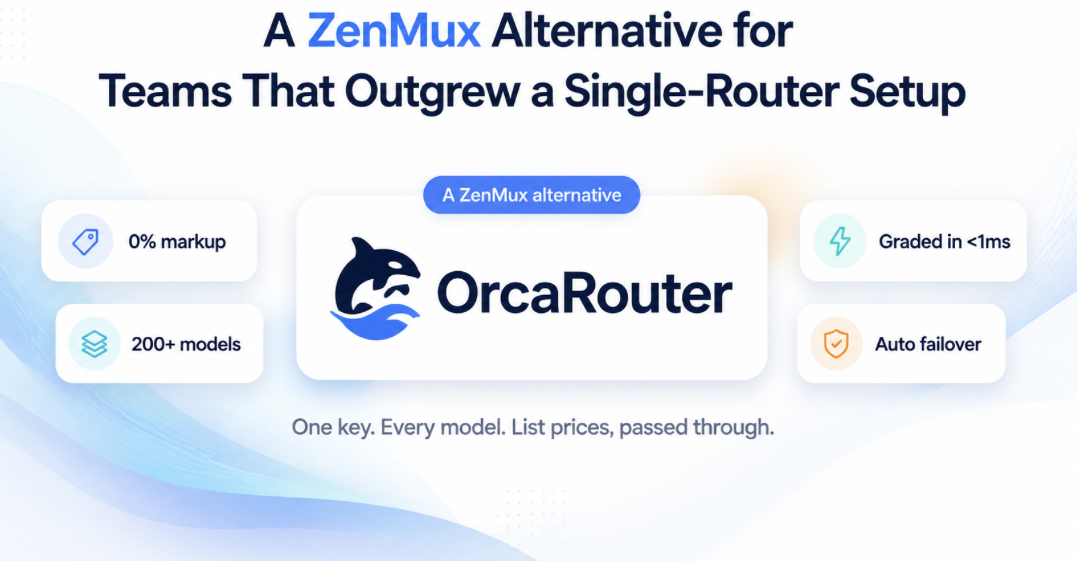
A ZenMux Alternative for Teams That Outgrew a Single-Router Setup
OrcaRouter is a ZenMux alternative built for teams that outgrew a single-router setup — with its answers to the six evaluation dimensions laid out in the zenmux alternative write-up — and one API key reaches 200+ models, provider list prices pass through at 0% markup, every prompt is graded in under a millisecond and routed to the cheapest model that clears your bar, and failover runs itself. If that short version is what you're shopping for, here is the long one — including the checklist you should hold up against any candidate you evaluate.
Searching for a ZenMux alternative is rarely a rejection of the idea of a model router. It usually means a team tried one, liked the promise, and outgrew the implementation. A single-router setup works while the workload stays simple: a few models, a fixed routing rule, one bill you can still explain. Then the use cases multiply — a coding agent that needs frontier models, a batch pipeline that wants cheap bulk models, a platform team that has to tell three departments where the budget went — and the router that was a shortcut becomes the bottleneck. That's when people start shopping, and the criteria stop being "does it route" and become "how well, and can I trust the numbers it produces?"
What the "ZenMux alternative" search is really asking
Teams searching for a ZenMux alternative usually aren't unhappy with the category. They want exactly what a router promises — many models behind one integration, routing logic that lives outside application code, and a single place to watch costs — but they've hit the limits of the specific setup they're on. The query is shorthand for: which platform gives me the same convenience without the constraints I've outgrown?
That framing matters, because it changes how you evaluate. ZenMux is a router in a category full of routers; the models it can reach are the same models any router can reach. What differs is the layer around the models: whether pricing is transparent, whether routing is a static rule or a per-request decision, whether failures are handled for you, and whether you could leave if you wanted to. Judge a candidate on those, not on which models it lists on its landing page.
The six things to compare (and what a good answer looks like)
Across the evaluation notes teams share, the same six dimensions come up every time. Here they are as a checklist, with the answer that satisfies each one.
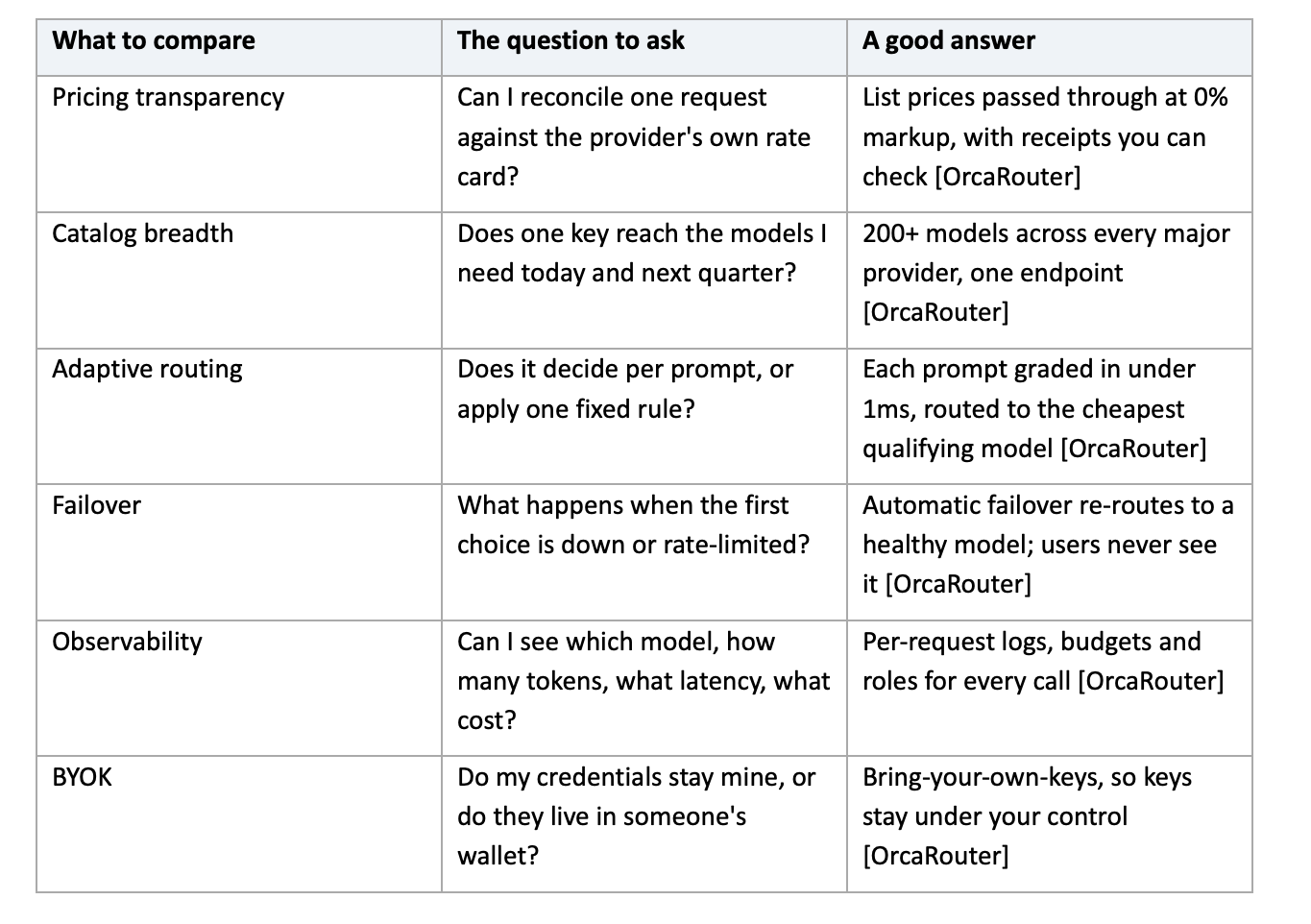
Run any candidate through that table and the differences stop being marketing and start being legible.
Pricing transparency is the foundation
Pricing is where trust in this category breaks first, because every other decision depends on it. The router you use picks "the cheapest model" by comparing prices; you set budgets and review bills by reading prices; your cost-optimization strategy is only as honest as the numbers underneath it. If a router adds its own margin on top of provider prices, every one of those numbers is distorted by an invisible fee — the "cheapest" model it picks is cheapest according to inflated prices, and the bill you're on is not the bill the provider charged.
OrcaRouter's answer is to not do this at all. Provider list prices are passed through at 0% markup — "provider price, no $0.00 added" — with glass-box receipts you can check against the provider's own rate card [OrcaRouter]. That single decision makes the whole downstream chain trustworthy: the price the router sees when it grades a prompt is the price you pay, and the price in the request log is the price the provider charged.
Catalog breadth: the menu the router can actually choose from
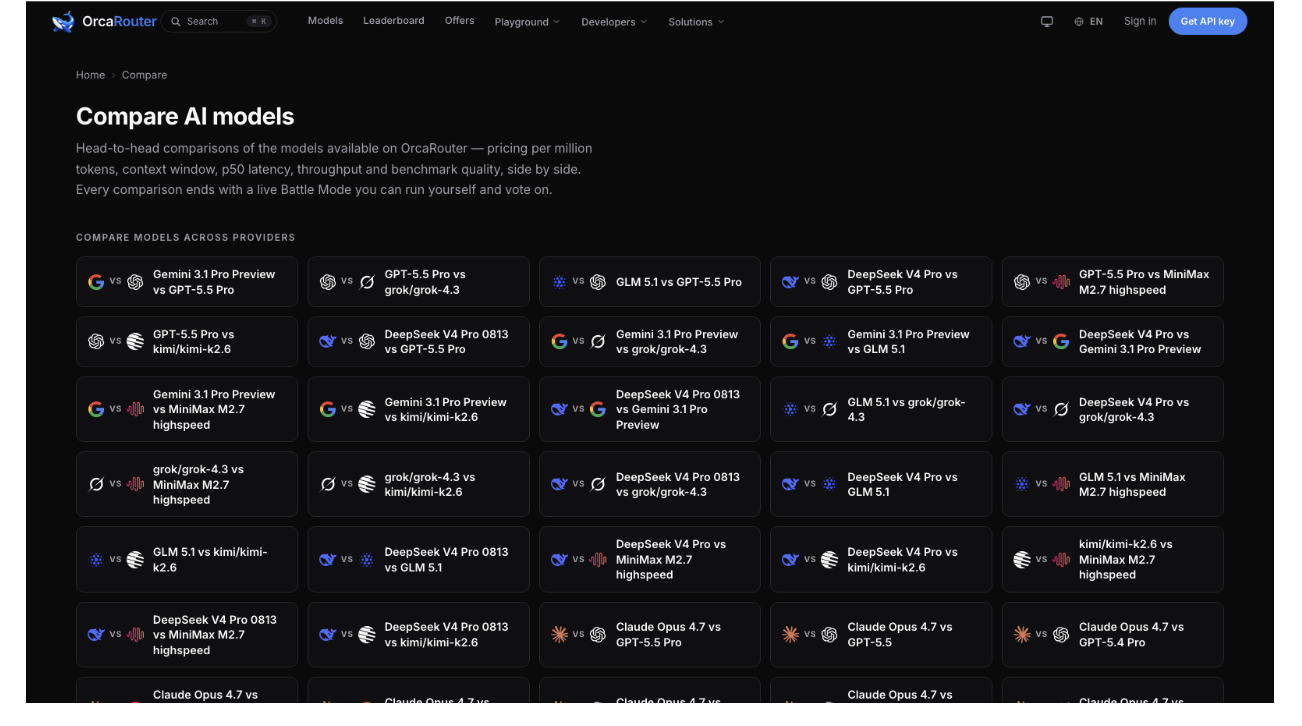
A router is only as smart as its menu. The second thing to compare is breadth: does one integration cover the models you use now and the ones you'll want to try next quarter? One OrcaRouter API key reaches 200+ models across every major provider — OpenAI, Anthropic, Google, Meta, Mistral, xAI, DeepSeek, Qwen, GLM, MiniMax — through a single endpoint [OrcaRouter]. New models appear without a new SDK, contract, or security review; trying something that launched this month is a config change, not a project.
Breadth is what makes adaptive routing worth having at all. The more granular the menu, the finer the cost-versus-quality tradeoff a router can make per request — and the more a per-request decision actually saves you at volume.
Routing that decides per prompt, and failover that runs itself
The third comparison is the one that separates routers that earn their keep from routers that are checkboxes: is routing a static policy, or a decision made per request?
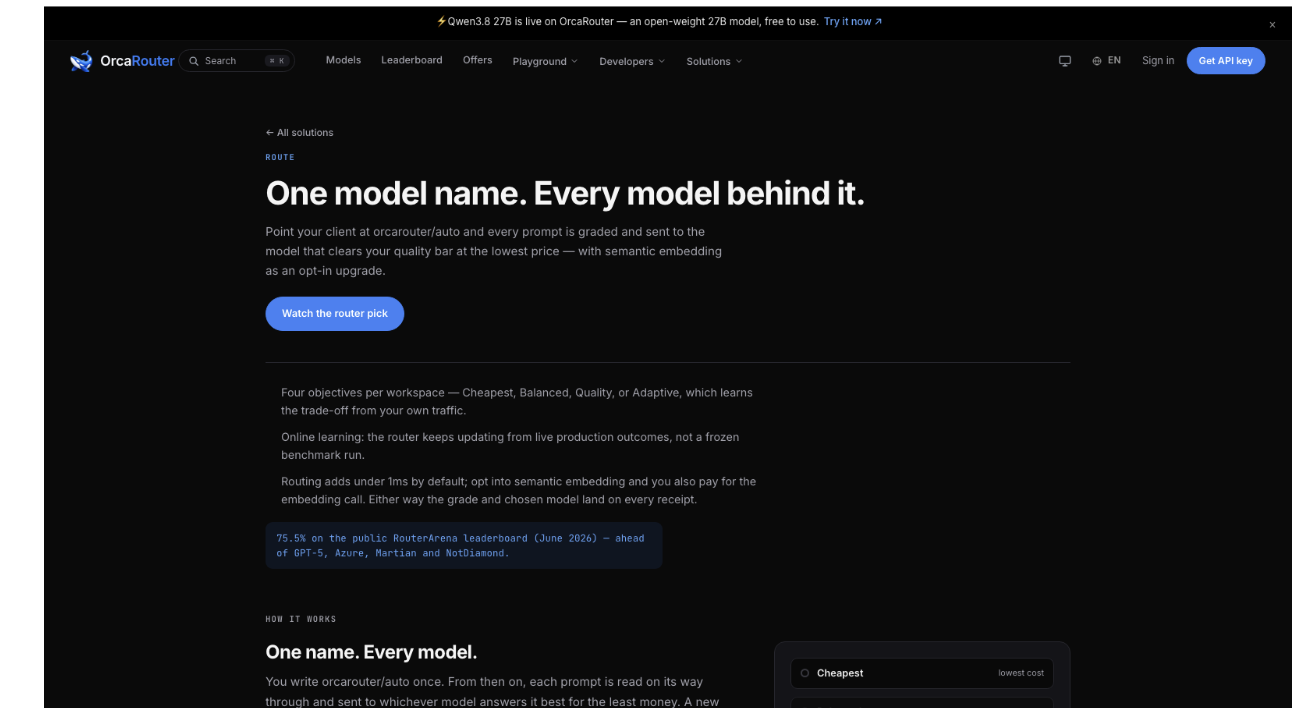
OrcaRouter grades each prompt before routing it. Every prompt is scored in under a millisecond, then sent to the cheapest model that meets your standard — easy questions hit a fast, inexpensive model, and hard ones escalate to a frontier model [OrcaRouter]. It's not a threshold you tune once; it's a decision made per request, so your quality bar holds while cost-per-token drifts downward.
The same engine handles failure. When a provider is down, rate-limited, or slow, automatic failover re-routes the request to a healthy model and the user never sees it [OrcaRouter]. No retry loop in your code, no 2 a.m. incident — and because failover runs on the graded score, the fallback is the next-best model for that exact prompt. If your current setup leaves failover to your own code, that difference alone is worth the move.
Observability, BYOK, and the parts that quietly prevent lock-in
The last two checklist items are about control — and they're the ones single-router setups tend to be weakest on. Lock-in rarely announces itself; it's the observability that vanishes the day you leave, and the keys that can't be reused elsewhere.
Per-request observability. Every request that crosses the router can be logged with which model answered, how many tokens it used, how long it took, and what it cost [OrcaRouter]. That turns "where did the budget go?" from spreadsheet archaeology into a query. Budgets and roles extend the same record across teams, so the log answers the question by team and feature instead of as one undifferentiated total.
BYOK. Bring-your-own-keys means your credentials stay yours — you're not forced to funnel your accounts through one platform's wallet, and the service adapts to how your security team wants keys handled. Combined with an OpenAI-compatible endpoint, your integration stays portable: your code writes to a request shape it already knows, and you could re-point it anywhere if you ever wanted to.
The takeaway
A ZenMux alternative is worth switching to when the specific setup you're on stops matching the workload — and it's worth evaluating on the six dimensions above, not on model lists. Pricing transparency is the foundation: if you can't reconcile a request against a rate card, nothing downstream is trustworthy. Catalog breadth makes routing worth having; adaptive routing and automatic failover are what turn a router from plumbing into a policy engine; observability and BYOK are what keep the whole thing honest and portable. OrcaRouter matches that checklist directly — 0% markup with list prices passed through, one key for 200+ models, prompts graded in under a millisecond, automatic failover, per-request logs, budgets and roles, and BYOK. If your current setup still makes you do the spreadsheet math, the compare page is a ten-minute way to see the difference.
Sourcing note: Product facts — one API key for 200+ models, prompts graded in under 1ms and routed to the cheapest qualifying model, 0% markup pass-through of provider list prices, automatic failover, per-request logs, budgets and roles, BYOK, and the OpenAI-compatible endpoint — are OrcaRouter's own published claims, checked on its homepage, /compare, and /solutions/adaptive-routing pages on August 22, 2026. No third-party benchmark or pricing data, and no claims about any competitor, are used in this article.